


Summarise with AI:



Today, the world’s leading software vendors are, in some form, SaaS: Microsoft, Salesforce, SAP, and Oracle. SaaS is their recurring revenue engine. The SaaS sector is undergoing a transformative phase, as AI has made mid-market SaaS app development accessible. Specifically, what's easy to miss amid all the noise: the impact on SaaS development costs.
AI makes it possible to build a solution without extensive technical expertise. One can build a SaaS solution in days or weeks using AI; that’s what pseudo-experts claim in 2026. Yes! If you’re building something the world figured out ten years ago, it's easier and more accessible.
However, to build something innovative for today, you will still need a team or an AI orchestrator with a strong sense of when to let the AI handle the data and when to step in with human intuition.
But that ease disappears the moment you try to build for today’s problems. Adding AI, building agents, and making systems behave reliably has the same level of complexity and challenge founders had a decade ago.
In this article, we break down the SaaS development costs. Costs have dropped for building something already built. AI can replicate in a few hours, days, or weeks. But for AI‑driven SaaS products, the total cost of building is now lower than it was before.
How much does it cost to build a saas product?
It depends on how you build. If you come from a non-tech background, without technical expertise, to turn a SaaS idea into a revenue stream, there are three popular methods:
- You can either partner with a tech co-founder or
- Do it yourself (DIY); create using AI-powered low-code no-code tools, or
- Hire a SaaS product development company
In the first two cases, it is hard to figure out the actual cost. It all depends on your strategy.
The second option is cheaper if you have got moderate technical expertise. The third one is the safe bet when one plans to build something like the gold standard.
If you are moving forward with option three, let’s put more detail on it. In the subsequent sections, we break down SaaS development costs, popular engagement models, and outline some cost-effective strategies for first-time founders.
Detailed breakdown of costs
The technology stack you choose, development model, the team size and where it is located (if outsourcing), are some of the heavy lifters in the project's cost structure.
1. Development Team
The process of developing software in-house is quite expensive, more than employing freelance programmers. At least 1.5–2 times the investment will be required when developing an in-house setup to employ highly skilled individuals.
| Partnership Type | Cost |
|---|---|
| In-House Developers | $15,000 - $50,000 |
| Freelancers | $5,000 - $20,000 |
| Outsourcing Agencies | $8,000 - $20,000 |
2. Technology Stack
The choice of tech stack in your project influences the development cost. It is common to use JavaScript-based technologies like React and Node.js that make the process cheaper. You can find solo developers as well as development agencies easily. Alternatives are Python and Ruby on Rails. Plus, cloud platforms add to the cost. Here’s what you will need to decide on.
- Programming language/frameworks/AI tools
- Cloud platforms (Azure, AWS, Google Cloud, etc.)
- Backend services (eg. Firebase, or Auto0)
Insight: Tech stack choice controls your speed of development and operational overhead.
Factors that influence overall cost
Several factors can influence the final cost, including:
- The complexity of the solution
- The type of product
- The type of development team
- The location of the development team
Let's explore each of these factors in detail.
Development costs based on project scope & complexity
Platform Complexity in SaaS Solutions represents the features, functions, users' roles, and interactions involved in the platform. The types of complexities that we could classify include micro complexity, basic complexity, average complexity, and complex complexity. Below is the cost estimation by levels of complexity:
- Simple App: A simple app with limited screens without features such as payment and integration. You can build it anywhere between $6k-20k.
- Intermediate Complex App: With an embedded logical layer for payment, integration, and features such as login, admin roles, etc.
- Complex SaaS Applications: Salesforce, SAP, Jira, are some popular examples of complex SaaS, built for large enterprises.
| Budget Tier | Development Cost |
|---|---|
| Simple SaaS | $5,000–$25,000+ |
| Intermediate SaaS | $25,000–$60,000+ |
| Full-Featured / Complex SaaS | $60,000–$1,50,000+ |
| Enterprise / Premium | $1,50,000+ |
Analysis drawn from Clutch’s “Top Mobile App Development Companies for SaaS” directory — Source.
Development costs based on team type
Can you manage the team? Or do you want a partner company to do an end-to-end job? In-house development is more costly. It takes lots of time to build a team, taking around 3-6 months.
The most economical option: hire a freelancer. It is the most cost-effective, but companies building flagship products don’t prefer it for many reasons, such as inconsistent quality, poor communication, etc.
Outsourcing is a viable strategy for developing a product while maintaining high standards. Here is an estimate of the average cost of different team options:
- In-House Team: You have complete oversight of the product. This is the highest-priced model. It may cost as much as twice the outsourcing cost.
- Freelancers: The most affordable option. You can build an app for $5,000 - $20,000.
- SaaS Development Company: Provides comprehensive services and expertise. Costs $8,000 - $25,000+.
Cost Insight: Compared to outsourcing, especially offshore, in-house development can be 30–50% more expensive, with some scenarios putting outsourcing at up to 3x cheaper.
In any case, before choosing between in-house, freelance, or outsourcing options, there are several points that should be noted. Every option is unique and has its strengths and weaknesses.
Type 1: In-House Team
An in-house team works directly within your startup environment. It keeps your sensitive data within the company. If you go with in-house development, expect a higher price tag.
Pros
- Quick access to the development team
- Control over development workflow
- Better understanding of company goals
Cons
- High costs
- Hidden expenses related to developer hourly rates
Type 2: Local Development Company
Hiring a local SaaS product development company can be expensive, especially in high-income countries like the USA, UK, UAE, and Canada. While this option eliminates time zone and cultural differences, the cost can be prohibitive for startups.
Pros
- No cultural and time zone differences
- Legal recourse available within the same jurisdiction
Cons
- High costs, especially in high-income countries
Type 3: SaaS Freelancers
This is your most viable choice if you have a limited budget. There are countless freelance portals, from LinkedIn to Upwork, to find expert developers. However, they may lack loyalty to your project and can switch clients easily.
Pros
- Expertise in developing functional SaaS products
- Cost-effective
Cons
- Limited control over workflow
- Potential lack of commitment
Type 4: Outsourced SaaS Development Team
Outsourcing development to a team in a different country can offer the best value for money, especially if the team is in a region with robust technological infrastructure. However, communication and cultural differences can pose challenges.
Pros
- Cost-effective
- Scalable team
- Access to a network of talented developers
Cons
- Potential communication barriers due to time zones
- Cultural differences may affect workflow
Cost based on location
Outsourcing allows you to get started quickly, skipping the recruitment process. Another benefit is that it is budget-friendly. However, this is not always true if a partner is not vetted, considering development costs worldwide. For instance, what costs $30,000 to build in the USA can be built in India for one-third less.
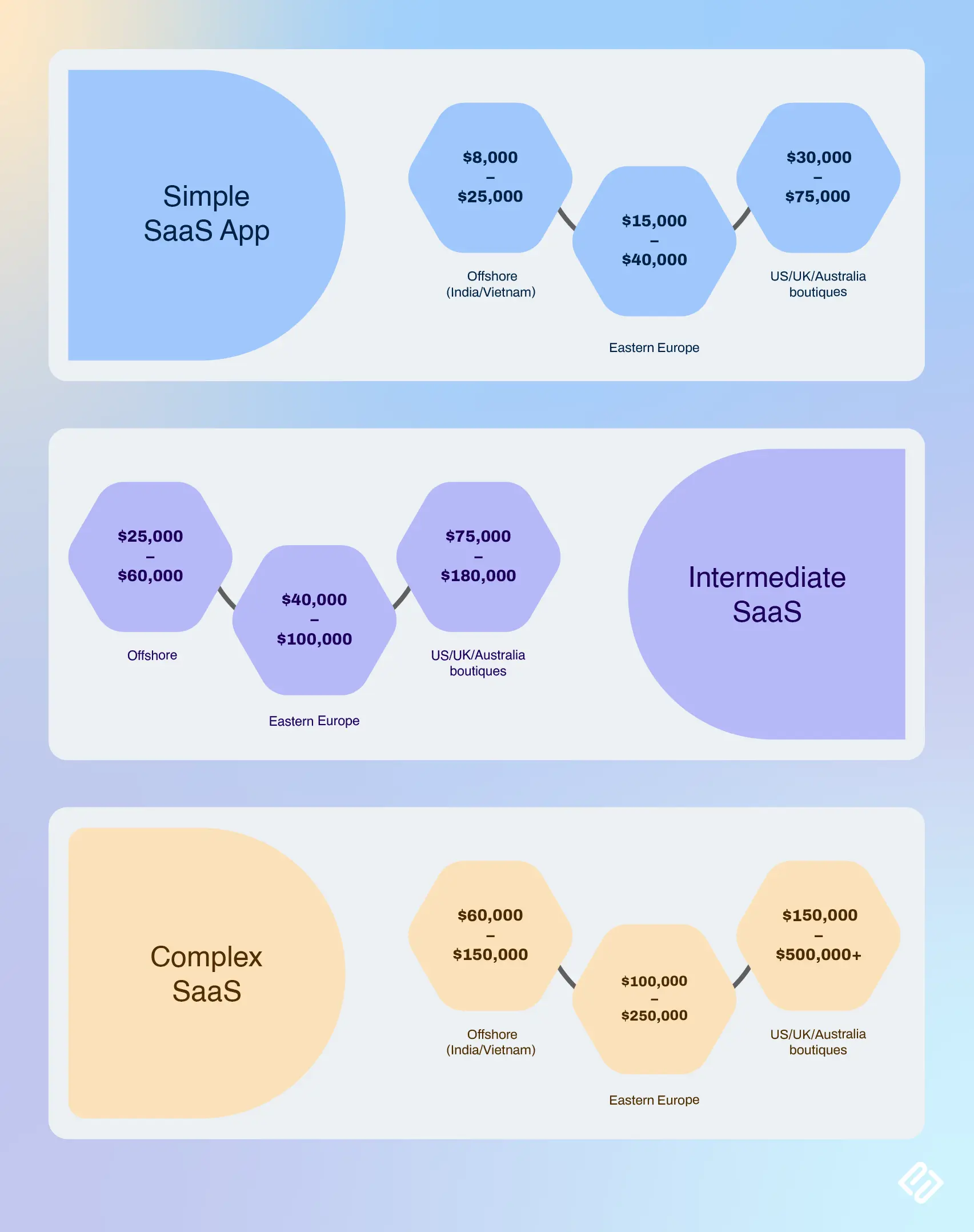
Simple SaaS App (MVP, basic features, 1 platform)
- Offshore (India/Vietnam): $8,000–$25,000
- Eastern Europe: $15,000–$40,000
- US/UK/Australia boutiques: $30,000–$75,000
Intermediate SaaS (multi-role access, integrations, 2 platforms)
- Offshore: $25,000–$60,000
- Eastern Europe: $40,000–$100,000
- US/UK/Australia: $75,000–$180,000
Complex SaaS (enterprise-grade, AI, compliance, full-stack)
- Offshore: $60,000–$150,000
- Eastern Europe: $100,000–$250,000
- US/UK/Australia: $150,000–$500,000+
Cost factors you shouldn't ignore
Factor #1: Application Complexity
Agentic, AI/ML capabilities, integration with external services and systems, and security and compliance-related features such as multi-factor authentication and audit trails require a high-stakes endeavor.
Factor #2: Technology Choices
Are you choosing a niche or popular tech? If niche, then it means you will need to hire specialized developers, which means higher development costs. Plus, it impacts development timelines, too.
Factor #3: Team Size and Location
Larger teams or those with highly skilled developers can cost more. Also, developers in different regions charge different rates. For example, developers in the U.S. generally charge more than those in India.
Opting for an India-based development team can be a cost-effective choice without compromising quality. A vast pool of skilled professionals and competitive rates make it a preferred software development company for SaaS development. It is the preferred choice for cost-effective, high-quality services at a fraction of the cost compared to North America and Western Europe.
Estimating the cost of SaaS development (with Prioxis)
Based on the SaaS projects we've completed, here's what honest budget planning looks like for a founder:
An MVP — authentication, core workflow, basic dashboard, one payment integration — runs $8,000–$25,000 with our team. Most founders try to build more than an MVP. That's where projects balloon. We push back on scope before writing a single line of code.
A full-featured SaaS with multi-tenant architecture, role-based access, third-party integrations, and admin analytics: $25,000+, typically across 4–5 months with a team of 4.
Where costs spiral — and where we stop you:
- Adding features mid-sprint without removing others
- Building for scale before you have 100 users
- Choosing native mobile before validating on web
In the 12 projects we've delivered in the last 18 months, the average scope creep was 23% of the original budget. We track this because we want you to know it before it happens to you.
If you want to talk through your spec before you're ready to spend, we offer a 45-minute working session. We'll tell you what's overengineered, what's missing, and what a realistic timeline looks like for your idea.