


Summarise with AI:



Personalization is no longer optional in today's digital landscape. AI-powered recommendation systems are actively influencing your experience. These clever algorithms consider user behaviour to give relevant content, such as recommending your next binge-worthy Netflix show or suggesting must-have Amazon purchases.
For companies, Building a recommendation system is a game-changer. They increase customer engagement, enhance customer satisfaction, and drive sales by presenting the right suggestions at the right moment. But how do they do it? What technologies enable them? And how can you create one for your company?
In this blog, we will learn all about how to build an AI system for personalized recommendations—everything you need to know to understand its main components and implement it successfully. Let's get started!
What Is An Artificial Intelligence Recommendation System?
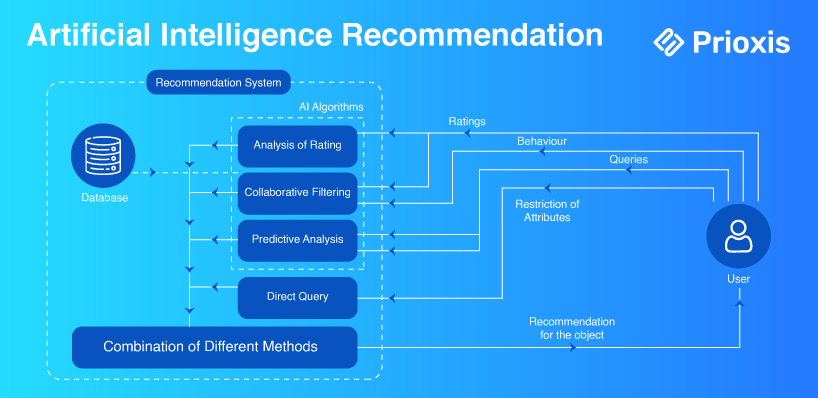
An AI-driven recommendation platform is an intelligent technology that creates a real-time personalized recommendation with feedback control of products, services, or content based on user behaviour and interest. It is similar to having a virtual assistant that continues to learn from your past activity and the activity of other comparable users in order to make suggestions to you.
Such systems are powered by advanced machine learning algorithms and statistical models to analyze data, forecast user interests, and offer personalized suggestions. Whether suggesting a movie on Netflix, a product on Amazon, or a playlist on Spotify, AI-powered recommendation engines streamline and individualize experiences for customers and drive business user engagement, conversions, and sales.
AI recommendation systems by 2026 have become the need of every sector, be it e-commerce and entertainment or healthcare and finance, which is impacting business-to-consumer interactions and tailoring services like never before.
Types of AI-powered Recommendation Systems
Let's discuss the four main categories of recommendation systems and how they work.
1. Collaborative Filtering Systems
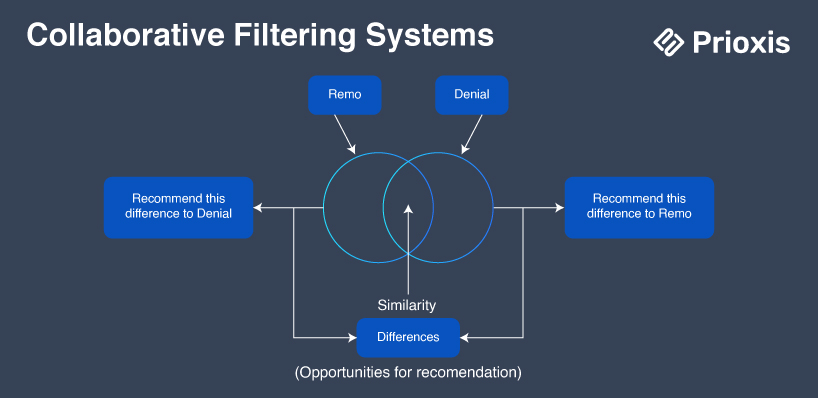
Collaborative filtering is perhaps the most popular recommendation method. It operates by examining user behaviour and interests to identify similarities between users or products. The underlying principle is that if two users have expressed interest in the same item, they are likely to share similar tastes for other items as well.
There are two primary forms of Collaborative Filtering:
Memory-Based Collaborative Filtering: Also referred to as neighborhood-based filtering, this approach predicts based on the likes of similar users or items.
- User-based filtering: Suggests items similar to what similar users have liked.
- Item-based filtering: Recommends items similar to what the user has liked before, based on other users' ratings.
Model-Based Collaborative Filtering: Employing machine learning models and statistical methods to study large collections of data and provide recommendations. This method comprises algorithms such as decision trees, latent factor models, and rule-based techniques.
Example
YouTube suggests videos based on what other users with similar viewing habits have watched, while e-learning sites such as Coursera suggest courses based on what other users with similar learning habits have taken.
2. Content-Based Recommendation Systems
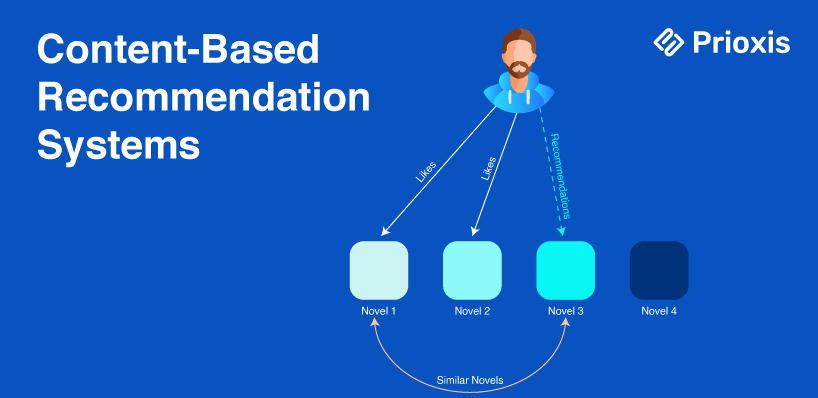
While collaborative filtering trusts user similarities, content-based systems recommend items due to a user's previous taste. This process compares item characteristics (genre, price, category) and connects them with the user's desires.
To establish a content-based system, Companies require two most important things:
- Item Attributes: In-depth descriptions of products, services, or content (release year, genre, price).
- User Interaction Information: User feedback in the form of clicks, ratings, purchases, or browsing history.
Content-based filtering comes in handy when little user rating information is present since it makes use of item attributes instead.
Example
- Amazon suggests items that are similar to what a user has bought earlier.
- Spotify creates personalized playlists based on what a user has listened to.
3. Hybrid Recommendation Systems
.jpg)
Hybrid recommendation systems blend different recommendation techniques to achieve greater accuracy and more appropriate recommendations. Hybrid systems overcome the drawback of a single method and are executed in two manners:
- Parallel Hybrid System: Applies various recommendation models together and aggregates their output.
- Sequential Hybrid System: Forward passes the outcome of one recommendation model to the next for improved suggestions.
Hybrid systems deliver improved personalization, increased accuracy, and better user interaction.
Example
Netflix uses collaborative filtering (examining user viewing behaviour) along with content-based filtering (reviewing movie attributes) to make recommendations of shows and films based on each user.
4. Knowledge-Based Recommendation Systems
Knowledge-based recommendation systems make recommendations according to domain knowledge and user needs instead of prior behaviour. These systems make recommendations based on contextual information and rules that have already been specified.
Unlike collaborative or content-based filtering, knowledge-based systems do not have cold-start issues (where insufficient historical data makes recommendations challenging). They are especially suitable for infrequently bought products or services, e.g., property or financial planning.
Strengths of Knowledge-Based Systems:
- They make highly relevant suggestions even in the absence of much historical user data.
- They provide understandable suggestions, with a clear explanation as to why a particular suggestion was made.
Example
- A travel portal suggests holiday offers to a visitor based on the visitor's spending limit, interest, and historical travel experience.
- We have developed Kunto, an AI‑powered healthcare platform that suggests individualized treatment regimens to patients based on their medical history and symptoms.
How Does an AI-Powered Recommendation System Work?
Let's discuss each phase in detail:
1. Data Collection
The core of an AI-based recommendation system is the data it accumulates. This data is collected from various sources to comprehend user behaviour, preferences, and item attributes.
Data Collected Types:
- User Behaviour Data – Records user actions like clicks, views, purchases, and ratings.
- User Demographic Data – Comprises personal details such as age, gender, and location.
- Item Data – Comprises product features such as descriptions, categories, and prices.
- Contextual Data – Parameters such as time of interaction, device used, and geolocation.
- Explicit & Implicit Feedback – Explicit feedback is comprised of user reviews and ratings, whereas implicit feedback examines browsing behaviour and interactions.
Challenges in Data Collection:
- Cold Start Problem – When new users or products have limited information, it becomes challenging to make accurate recommendations.
- Data Privacy & Compliance – User data should be collected safely and according to data protection policies.
2. Data Storage
Data, after collection, has to be stored in a systematic and retrievable manner. Cloud databases, data warehouses, and distributed storage mechanisms are utilized by AI-based systems to store big data effectively.
Storage Techniques:
- Relational Databases (SQL-based) – Used for structured and well-organized data storage.
- NoSQL Databases – Applied to unstructured and semi-structured data, such as user activity and logs.
- Cloud Storage Solutions – Solutions like AWS, Google Cloud, or Azure offer elastic storage solutions.
Efficient data storage makes sure that huge volumes of user and item-related data are easily accessible for processing and analysis.
3. Data Analysis
Once the data is stored, AI models process it to derive meaningful insights. Machine learning algorithms run through huge datasets to detect patterns and correlations.
Key Data Processing Steps:
- Data Cleaning – Elimination of duplicate, irrelevant, or incorrect data.
- Data Normalization – Converting data into a uniform format for proper comparisons.
- Feature Engineering – Deriving important features from raw data to enhance model precision.
AI-driven recommendation systems employ methods like:
- Natural Language Processing (NLP) – To process text-based data, such as product descriptions and reviews.
- Computer Vision – To interpret image-based recommendations.
- Deep Learning Models – To make predictions about user preferences based on underlying patterns in data.
4. Data Filtering & Recommendation Generation
After analyzing the data, AI-based filtering methods are used to create personalized recommendations.
Filtering Methods:
- Collaborative Filtering – Suggests products based on user similarity or common tastes.
- Content-Based Filtering – Recommends products with similar features to those liked before by the user.
- Hybrid Filtering – Uses a combination of several filtering methods for better accuracy.
Creating Personalized Recommendations:
The system uses machine learning models like:
- Matrix Factorization – A method that estimates missing user-item interactions.
- Neural Networks – Deep learning algorithms for sophisticated pattern recognition.
- Reinforcement Learning – Improves recommendations over time based on user interactions.
The final recommendations are delivered in a user-friendly format, e.g., personalized product lists, music playlists, or movie recommendations.
Top Use-cases of AI Recommendation Systems
1. Supply Chain Management
Recommendation systems driven by AI streamline inventory and cut waste through an examination of historical sales patterns, supplier lead times, and present demand dynamics. This makes them more efficient, costs less, and creates less environmental degradation.
2. Retail & E-Commerce
Customer information like browsing history and interests is used to create personalized product recommendations by AI engines. The integration of AI in retail business operations maximizes customer satisfaction and increases sales through personalized shopping experiences.
3. Media & Entertainment
AI examines user listening and viewing habits to recommend relevant music, TV shows, and movies. Ongoing learning optimizes recommendations, enhancing user interaction and retention.
4. Healthcare
AI-powered healthcare recommendations examine patient information to offer customized treatment and medication recommendations. This improves medical accuracy, enhances patient outcomes, and maximizes healthcare utilization.
5. Financial Services
AI recommendation engines process financial habits and transaction histories to recommend personal financial products, increasing customer satisfaction and revenue for financial institutions.
6. Travel & Hospitality
AI in the travel industry personalizes hotel, flight, and travel service recommendations based on user budget and preferences. Personalization leads to improved user experience and additional revenue for travel companies.
Benefits of AI Recommendation Systems
AI-driven recommendation systems are revolutionizing companies by providing personalized experiences, boosting sales, and enhancing customer engagement. Here is the value they bring:
- Elevated Sales: By presenting appropriate products or services, AI-driven recommendations enhance conversion rates and average order value. Personalization raises customer satisfaction, promoting brand loyalty.
- Improved Customer Experience: Customized recommendations make browsing more interesting and convenient, allowing users to easily find products or content aligned with their interests.
- Increased User Engagement: AI-powered recommendations make users stay longer on sites, generating more interaction, page views, and repeat visits.
- Effective Product Discovery: Recommendation systems make it easy to navigate, minimizing bounce rates and abandoned carts by guiding users to find what they're looking for with ease.
- Data-Driven Insights: Companies obtain precious customer behaviour information, facilitating data-driven decisions in marketing, inventory, and product development.
- Higher Customer Retention: A customized experience builds anticipation, leading to repeat visits and increased use of the platform.
- Competitive Advantage: In a saturated market, AI suggestions distinguish companies, drawing and holding consumers through individualized experiences.
- Inventory Management Optimized: Through trend analysis, AI forecasts demand, letting trending products be in stock while minimizing excess inventory from over-orders.
Wrapping Up
AI-powered recommendation engines provide a commercial benefit in terms of increased client satisfaction, engagement, and income. Their performance relies on successful implementation, constant optimization, and the ability to adapt to changing consumer behaviour.
You and Prioxis collaborate to create advanced recommendation platforms that provide genuine business benefits. Our adaptable approach ensures that your system develops to meet changing needs, providing unique experiences that consistently satisfy users.
Ready to boost your business with AI software development services? Join Prioxis today and tap into the maximum potential of intelligent personalization!