


Staff Augmentation vs IT Outsourcing: A Practical Guide for CTOs and Founders


Summarise with AI:



Key Takeaways
- Staff Augmentation This model offers flexibility and control over your external team.
- IT Outsourcing It provides a hands-off approach to complete the entire project.
- Considerations Project size, complexity, and desired level of involvement.
When managing your business's IT needs, two popular models often come to the forefront: IT staff augmentation and IT outsourcing. Both offer unique benefits and can be ideal solutions for different scenarios. Understanding these models will help you decide which one suits your business needs best.
Staff augmentation temporarily brings external talent into your team, offering flexibility and specialized skills. Software outsourcing transfers entire projects or functions to third parties, focusing on cost savings and efficiency. The choice between these models depends on your project requirements and business goals.
But what exactly sets these two models apart, and which is best for your business operations? Don't worry – we're here to help guide you.
What is IT Staff Augmentation?
IT staff augmentation offer a flexible staffing approach where businesses strategically hire team of dedicated developers on a temporary basis to fill specific roles or complete particular projects. This model allows companies to scale their workforce up or down based on project demands without the long-term commitment of hiring full-time employees.
Advantages and Disadvantages of IT Staff Augmentation
Benefits of Staff Augmentation
A recent market analysis predicts that global investments in IT staff augmentation services will surge to roughly $81.87 billion by 2025, highlighting the increasing demand for flexible talent solutions across industries.
- Flexibility You can quickly scale your team according to project needs, ensuring you have the right talent at the right time.
- Cost-Effective Avoid the overhead costs associated with hiring full-time employees, such as benefits and long-term salaries.
- Expertise Gain access to specialized skills and knowledge that may not be available within your existing team.
- Control Maintain direct control over the augmented staff and project outcomes, ensuring alignment with your business objectives.
Disadvantages of Staff Augmentation
- Management Overhead Your internal team is responsible for managing the augmented staff, which can add to their workload.
- Integration Challenges Integrating temporary staff into your existing team can be challenging, particularly in terms of communication and workflow alignment.
- Short-Term Focus Staff augmentation is often project-based, which may not be suitable for long-term strategic initiatives.
Challenges Associated With Staff Augmentation
While IT staff augmentation can be beneficial, it also presents certain challenges. Addressing these effectively is crucial to ensure the augmented staff enhances your operations as intended. Here are some common issues and ways to handle them:
- Culture and Communication Gaps
Challenge: New staff may struggle to fit into your company culture, leading to miscommunication and team discord.
Solution: Foster an inclusive environment, provide thorough on-boarding about company values and practices, and organize regular team activities to bridge gaps.
- Learning Curve and Training
Challenge: Temporary staff might need considerable time to get up to speed, potentially slowing down projects.
Solution: Create structured training programs, maintain clear project documentation, and pair new staff with existing team members for faster integration.
- Maintaining Work Quality
Challenge: Augmented staff may produce work that doesn't meet your usual standards or methods.
Solution: Set up regular progress checks, establish clear performance metrics, and provide ongoing feedback and guidance.
- Data Security and Confidentiality
Challenge: Bringing in external staff could increase security risks and potential confidentiality breaches.
Solution: Have all augmented staff sign non-disclosure agreements, train them on security policies, and restrict access to sensitive information as needed.
- Over reliance and Long-term Planning
Challenge: Depending too much on augmented staff can leave your organization vulnerable and hinder internal skill development.
Solution: Use staff augmentation strategically for specific needs or temporary boosts, while focusing on building internal capabilities for the long term.
When to Choose Staff Augmentation
- Flexibility and Scalability
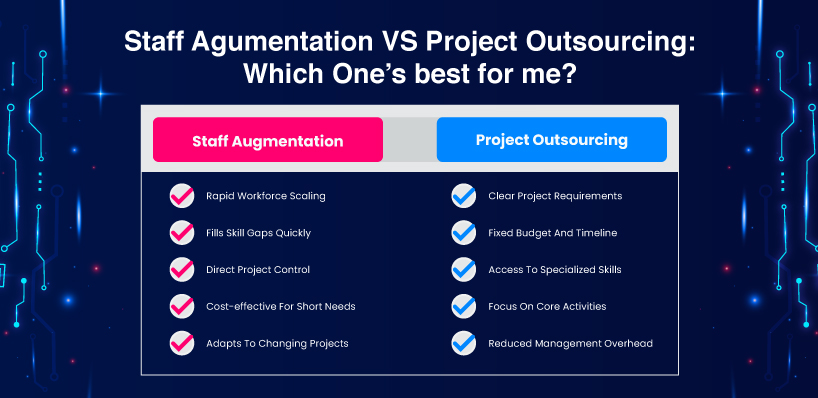
Staff augmentation is perfect when you need to quickly scale your workforce up or down. Whether it’s short-term or long-term, this model allows you to adjust your team size based on project needs.
- Short-Term Skill Gaps
When your team lacks specific skills for a project, staff augmentation fills these gaps swiftly without the commitment of long-term hiring.
- In-House Control
If maintaining control over projects is essential, staff augmentation lets you integrate new members into your team, preserving your company culture and management practices.
- Cost-Efficiency
This model is cost-effective for temporary or sporadic needs, as you only pay for additional expertise when required, avoiding the expenses of hiring and training full-time employees.
- Project-Based Work
For projects with changing requirements, staff augmentation offers the flexibility to meet evolving demands.
What is IT Outsourcing?
IT outsourcing involves hiring an external company to handle your IT functions or projects. This model can include a wide range of services, from software development to network management, allowing businesses to leverage external expertise and resources.
Advantages and Disadvantages of IT Outsourcing
Benefits of IT Outsourcing
Experts predict global outsourcing spending will reach $1.1 trillion by 2025. Why is this happening? Here are some main reasons:
- Cost Savings Outsourcing significantly reduce costs by eliminating the need for in-house infrastructure and reducing labour expenses.
- Access to Global Talent Tap into a global pool of talent, ensuring you have access to the best expertise and latest technologies.
- Focus on Core Business Free up internal resources to focus on core business activities and strategic initiatives.
- Scalability Easily scale services up or down based on business needs, ensuring flexibility and efficiency.
Disadvantages of IT Outsourcing
- Loss of Control Outsourcing involves handing over control of certain functions to an external provider, which can lead to concerns about quality and consistency.
- Communication Barriers Differences in time zones, language, and culture can create communication challenges.
- Security Risks Sharing sensitive business information with an external provider can pose security risks if not managed properly.
- Dependency Over-reliance on an external provider can make it difficult to transition back to in-house operations if needed.
Potential Drawbacks of Outsourcing
While outsourcing offers several benefits, it also comes with challenges that need careful management:
- Reduced Oversight
Challenge: Outsourcing can lead to less control over tasks, potentially impacting quality, timeliness, and alignment with company goals.
Solution: Create detailed contracts and SLAs outlining quality standards, deadlines, and deliverables. Monitor performance regularly and maintain open communication with the outsourcing partner.
- Communication Challenges
Challenge: Differences in language, time zones, and culture can lead to misunderstandings and delays.
Solution: Use video conferencing and collaborative tools for clearer communication. Set up a communication protocol specifying frequency and format of updates. Consider cultural and language training for key staff.
- Unexpected Expenses
Challenge: Perceived cost savings may be offset by unforeseen costs like legal fees, transition expenses, and management overhead.
Solution: Perform a comprehensive cost-benefit analysis before outsourcing, considering all potential expenses. Regularly review the relationship to ensure it remains cost-effective.
- Quality Concerns
Challenge: Outsourced services might not meet expected quality standards, affecting product delivery and customer satisfaction.
Solution: Establish and enforce strict quality control procedures with the outsourcing partner. Conduct regular quality assessments and provide feedback.
- Security Vulnerabilities
Challenge: Outsourcing can increase risks related to data security and intellectual property protection.
Solution: Verify that the outsourcing partner has strong security measures in place. Include robust data protection clauses in contracts and consider regular security audits.
When to Choose Project Outsourcing
- Well-Defined Projects
Outsourcing is ideal for projects with clear requirements and a documented scope of work, especially for fixed-price projects with set timelines and deliverables.
- Cost Predictability
Outsourcing provides budget predictability by agreeing on costs and timelines upfront, helping manage project budgets effectively.
- Specialized Expertise
If your project needs specialized skills not available in-house, software outsourcing allows access to vendors with the necessary expertise, ensuring high-quality outcomes.
- Focus on Core Competencies
Outsourcing non-core activities lets your organization concentrate on its main strengths, enhancing efficiency and business performance.
- Reduced Management Overhead
Delegating project management to the vendor reduces your management responsibilities, allowing you to focus on strategic business aspects.
Staff Augmentation vs Outsourcing: A Comparative Table
Flexibility and Control
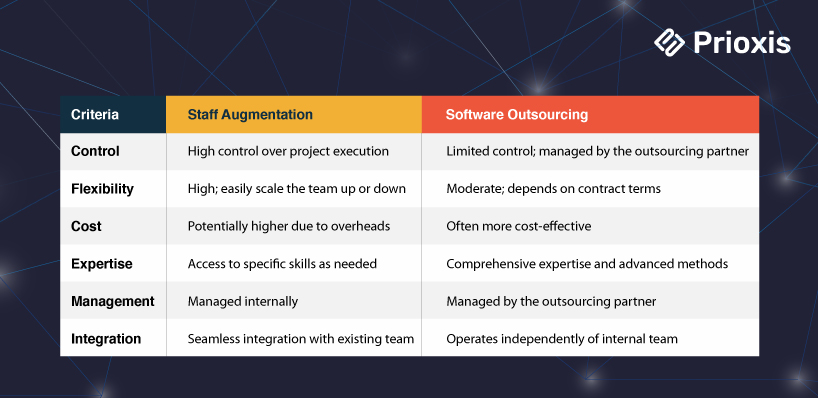
- Staff Augmentation Offers greater control over the augmented staff and project outcomes, making it ideal for businesses that need specific expertise for short-term projects.
- IT Outsourcing Provides flexibility in terms of resource allocation but involves less direct control over the outsourced functions.
Cost Considerations
- Staff Augmentation Can be cost-effective for short-term needs, avoiding the long-term costs of full-time employment.
- IT Outsourcing Often leads to significant cost savings through reduced labour and infrastructure expenses but may involve hidden costs related to management and coordination.
Skill and Expertise
- Staff Augmentation Allows businesses to bring in specialized skills as needed, making it suitable for projects requiring niche expertise.
- IT Outsourcing Offers access to a broader range of skills and technologies, leveraging the provider's expertise and resources.
Management and Integration
- Staff Augmentation Requires internal management of the augmented staff, which can add to the workload but ensures better alignment with business goals.
- IT Outsourcing Reduces the burden of management but can create challenges in terms of communication and integration.
Making the Right Choice for Your Business
Choosing between staff augmentation and IT outsourcing company depends on your specific business needs, project requirements, and long-term goals. Here are some questions to help guide your decision:
- What is the scope and duration of your project?
- Do you need specialized skills temporarily or long-term support?
- How important is control and direct communication with the team?
- What are your budget constraints and cost-saving goals?
- Are you equipped to manage an augmented staff, or do you prefer to delegate to an external provider?
Future-Proofing Your Business
Both staff augmentation and IT outsourcing can play a role in future-proofing your business. By leveraging these models, you can stay agile and responsive to changing market demands and technological advancements.
Staff augmentation allows you to quickly adapt to project needs and access specialized skills as required. This flexibility can help you stay competitive and deliver high-quality products and services to your customers.
IT outsourcing enables you to leverage external expertise and resources, reducing the burden on your internal team and allowing you to focus on strategic initiatives. By partnering with a reliable outsourcing provider, you can stay ahead of technological trends and continuously innovate.
Final Decision: Staff Augmentation or IT Outsourcing?
If you require temporary expertise for short-term projects and want to maintain direct control, staff augmentation may be the right choice for you. On the other hand, if cost savings, access to a wide range of skills, and focusing on core business activities are your priorities, IT outsourcing could be the ideal solution.
Looking to Hire Top Talent for Your Next Project?
Deciding between staff augmentation and outsourcing depends on your business’s specific needs and strategic goals. Both strategies can be valuable for resource management, helping businesses adapt to market demands, technological advancements, and internal capabilities.

Related Blogs
What Is Cloud-Native Architecture? Pros, Cons and Key Components
Explore practical insights from engineers who build scalable digital products every day.

Top Reasons To Hire A .NET Developer
Explore practical insights from engineers who build scalable digital products every day.
Top 9 Cloud Benefits: Productivity, Innovation & Growth
Explore practical insights from engineers who build scalable digital products every day.
Benefits of a Dedicated Development Team Model
Explore practical insights from engineers who build scalable digital products every day.
Top 12 Software Development Methodologies
Explore practical insights from engineers who build scalable digital products every day.
Why Cloud Integration Matters: Is Your Business Ready?
Explore practical insights from engineers who build scalable digital products every day.
.NET Core vs .NET Framework: Key Differences That Matter
Explore practical insights from engineers who build scalable digital products every day.
Why Is Azure DevOps the Key to Faster Business Growth Today?
Explore practical insights from engineers who build scalable digital products every day.
Azure DevOps Pipelines: Tools for Smoother Deployments
Explore practical insights from engineers who build scalable digital products every day.
On Premise vs Cloud Computing: Cost, Security & Scalability
Explore practical insights from engineers who build scalable digital products every day.