


Aviation MRO Software: Complete Guide to Modern MRO Systems for Airlines and Operators
 Admin
Admin



Summarise with AI:



Over 4.5 billion passengers fly globally each year. Global air travel is growing at a 4.9% year-over-year rate. But, behind every flawless flight on the horizon is the hidden byzantine process: MRO (Maintenance, Repair, and Overhaul).
Historically, MRO in aviation was little more than a heavy-duty garage where major processes were manual and analog. Today, the grease-and-wrench era has traded places with algorithms. For example; computer vision is being used in activities like inspection. Coating shops are being handed over to machines in the elite aviation businesses.
Aviation software algorithms chewing through millions of data points can predict component life or failure with great accuracy.
Machines seem to be taking over high-risk, highly repetitive tasks such as visual and external inspections, predictive decisions, and document processing in highly regulated industries like aviation.
This statement might sound like a sci-fi concept, because the reality of the MRO industry is different. Major MRO businesses still operate on pen and paper.
Currently, only 6% of businesses have the digital runway to integrate hottest technologies such as artificial intelligence; McKinsey & Company research underscores.
Much of this comes down to a wide range of challenges in adopting new technologies, which we have already discussed in the MRO modernization guide. Not to mention, in this industry, supply chain disruptions and skilled technician shortages are an ever-present reality.
Plus, the MRO aviation industry is notoriously famous for its manual way of working. Physical forms and manual tracking still devour roughly 30% to 40% of a technician's maintenance time. And this massive hit to everyday productivity is draining millions of dollars from the industry. Modern MRO software offers a clean, efficient path to address everyday challenges.
The guide breaks down the operational advantages of using modern MRO systems, and the cost of bespoke MRO software in 2026. You’ll also get a look at common implementation roadblocks alongside a practical blueprint for your digital transformation.
An Overview of Modern MRO Systems and Their Types in Aviation
Modern MRO systems combine a set of technologies such as artificial intelligence, internet of things, cloud computing, and robotics and drones.
Enterprise-level MRO systems feature a complete suite for maintenance and engineering, supply chain and inventory management, asset management, and tracking systems.
Behind the scenes, a fusion of advanced technology, global and specialized human expertise executes a highly complex process of a highly complex maintenance, repair and overhaul.
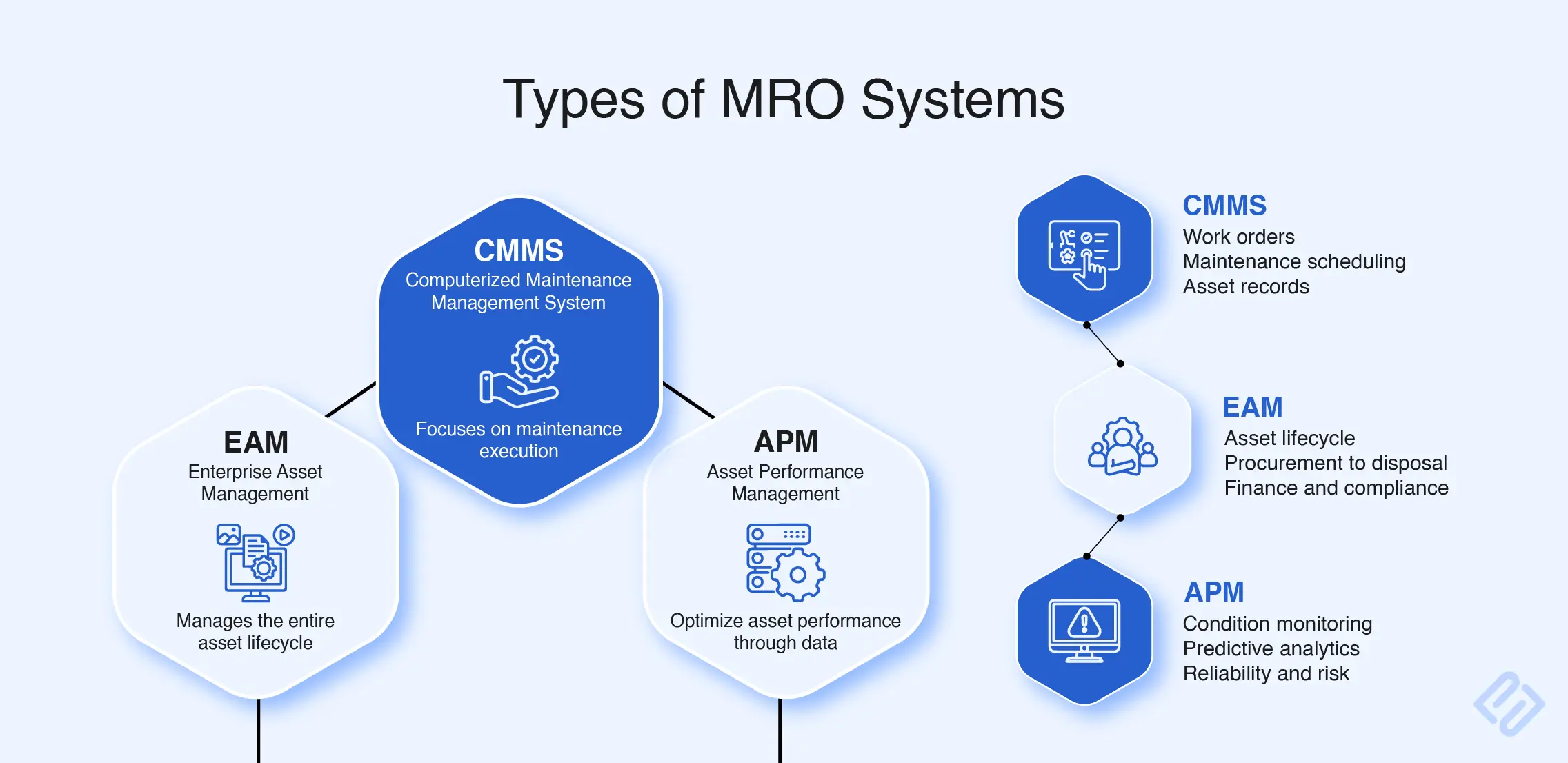
1. Computerized maintenance management systems (CMMS)
CMMs are great at automating or handling structured tasks. If a process includes the same, repeatable steps, these systems can mimic and learn how to execute processes in no time.
These platforms are cloud-based, bringing data together in one place for a unified view. They are used to manage data, history, logs, or any kind of information related to your operations such as hangars, stations, and parts, at one place, making asset management far simpler.
Moreover, you can connect CMMs with ERP systems, technical logs, and IoT data. Businesses today use both browser-based tools and mobile apps.
2. Enterprise asset management (EAM) systems
EAMs are mainly used by companies with multiple sites, plants, or departments. They are also known as just Enterprise System (ES). In general, an EAM system features modules for a wide range of operations such as planning, management, supply chain, and finance.
They provide an efficient way to sale through data-driven workflow that would otherwise require an arsenal of tools and a monotonous cross-department symphony. Furthermore, you can integrate third-party apps, such as CRMs for an extended functionality.
In an airline context, an EAM suite might manage not only aircraft support assets but also hangar infrastructure, ground support equipment (GSE), and airport facilities.
Let’s say a company uses Oracle EAM which is a part of Oracle E‑Business Suite. The company can use the EAM to manage tow tractors, GPU units, air‑conditioning carts, baggage systems, fuel farm pumps, and even HVAC in hangars. While Oracle’s other modules handle purchasing, inventory, HR, and financials.
3. Asset performance management (APM) systems
Asset Performance Management (APM) systems sit on top of your assets and maintenance data. They are technically the “analytics and prediction layer” in a broader MRO environment. These systems use modern technologies such as sensors and AI to keep equipment running longer.
In aviation, APM tools take flight, engine, and sensor data and turn it into early warnings, and fleet level insights.
APM monitors assets, analyzes their behavior, and recommends or automates actions to improve reliability and performance. It focuses specifically on the “in operation” phase: once the asset is in service, how do we keep it healthy, safe, and productive using data instead of gut feel.
Most APM offerings are composites which means several capabilities are packaged together inside them. They are integrated with EAM/CMMS and IoT platforms. These systems work by consuming flight and engine data.
The Role of Digital MRO Systems in Modern World
A report from Mordor Intelligence suggests that software-driven MRO operations can reduce total ownership costs by as much as 20-30% over four to five years.
In modern organizations, these solutions are widely used for data and asset management, asset tracking, and simplifying overall maintenance operations.
One of their biggest advantages is data centralization. When all information is available in one place, teams get a clearer view of asset status, maintenance schedules, and overall operations, making management much more efficient.
Although productivity gains are difficult to quantify, experts agree that in the AI era, the ability to respond quickly to changing business requirements is perhaps the great advantage these systems offer.
Plus, modern software helps businesses drill down through mountains of data and turn it into concrete takeaways. Today, businesses look to drive core strategic decisions alongside proactivity and business gains.
Modern MRO systems have moved far beyond basic backend support. They now sit at the center of enterprise operations.
The era of human-driven oversight is giving way to something far more powerful. With AI and digital twins in the core operations, the industry is moving slowly towards a true autonomous world where machines may execute the tasks we can’t yet imagine.
The Strategic Advantage of Implementing MRO Systems
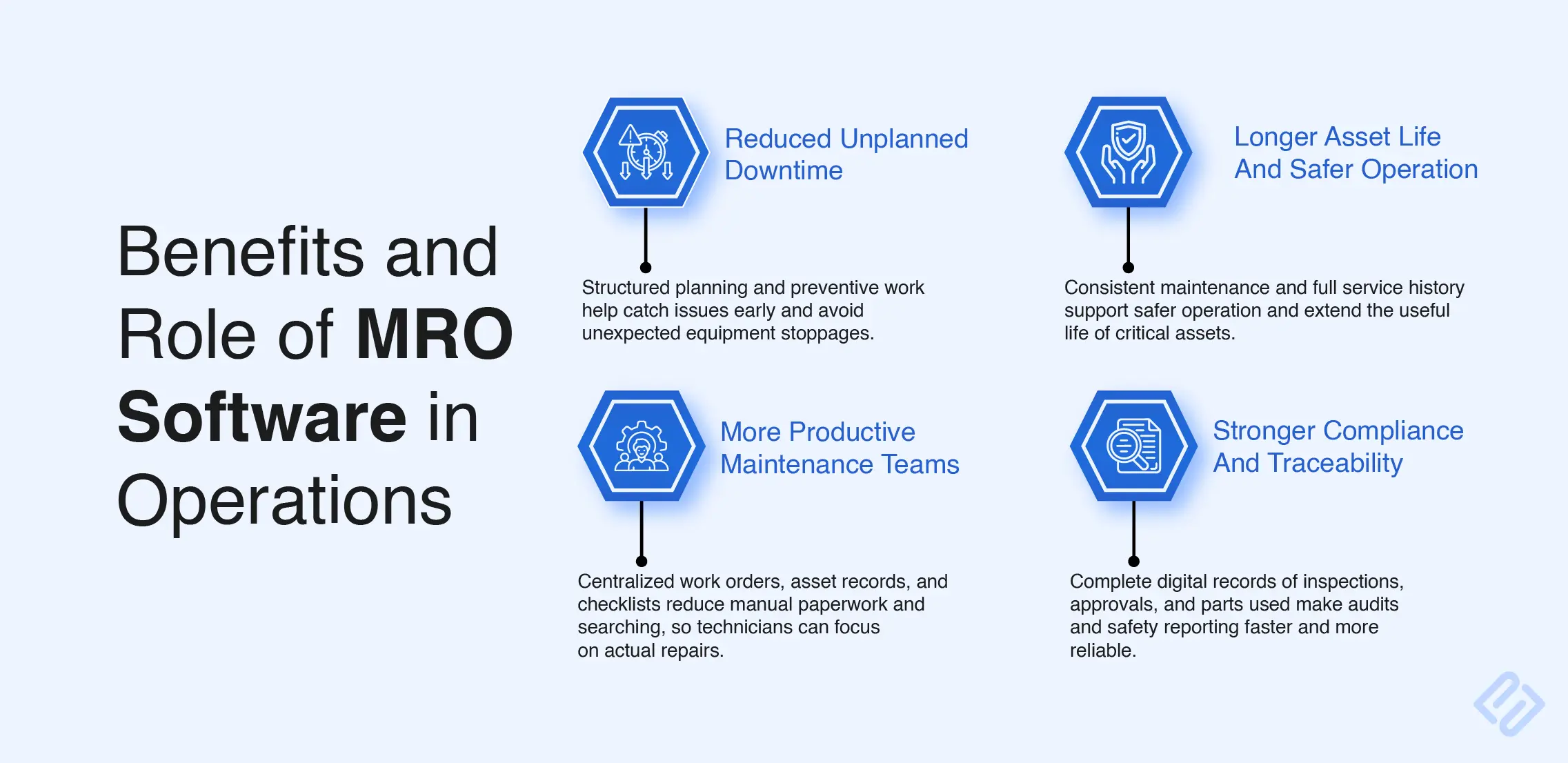
Most MRO operators are still running on tribal knowledge. Operators spend hours looking for information. The real‑time sync is a headache. Meanwhile, data driven maintenance has already shown it can cut downtime and improve planning. AI is pushing that even further.
Custom-built solutions prices have reached sky-high, but in many cases, they’re not even necessary. There are several SaaS tools available today that make it much easier to collaborate.
Furthermore, they play a crucial role in keeping aircraft compliant. Industry research backs this up. A McKinsey study on digital MRO found that organizations that embrace digital tools can cut maintenance spending by roughly 10–20%.
MRO software is not a “nice digital extra”. It is the backbone that lets maintenance teams see the full picture, act earlier, and prove that the fleet is being managed in a safe and disciplined way.
Core Features to Look for in Custom MRO
Modern MRO systems don’t run in isolation. The strength of these platforms is that they connect entire data, help operators build technology-driven workflows aimed at reducing working hours.
1. Management Features
Most SaaS solutions come with a pre-built compliance framework. They are built in such a way that automatically updates data to align with global regulatory standards such as the Federal Aviation Administration (FAA) and the European Union Aviation Safety Agency (EASA).
Custom software, on the other hand, is crafted to simplify complex business workflows that off-the-shelf solutions choke on. It is built around your operational DNA.
If it is a SaaS solution, look for the features it provides for operational management. It must provide your team with the capability to coordinate without losing visibility. For example; look at how it tracks context such as origin and assigned technician. Furthermore, analyze features that software provides to manage all these things without micromanagement.
2. Inventory Features
In aviation, inventory management is much deeper than storing assets in a database. It is a backbone of compliance and safety in industries such as aviation. It is critical to maintain an aircraft’s legal airworthiness.
The flawless supply chain indirectly depends on effective inventory management. As a part of the broader ecosystem, it indirectly plays a critical role in Aircraft on Ground (AOG) time reduction.
A modern MRO system addresses this by embedding inventory awareness directly into maintenance workflows.
In traditional systems, it is an isolated component. Modern MRO SaaS tool connect inventory systems with various internal and external modules, creating a single source of truth.
Over time, this integration helps organizations move from reactive procurement to predictive stocking. Patterns in usage, lead times, and supplier performance become visible, allowing maintenance operations to run with fewer surprises and tighter cost control.
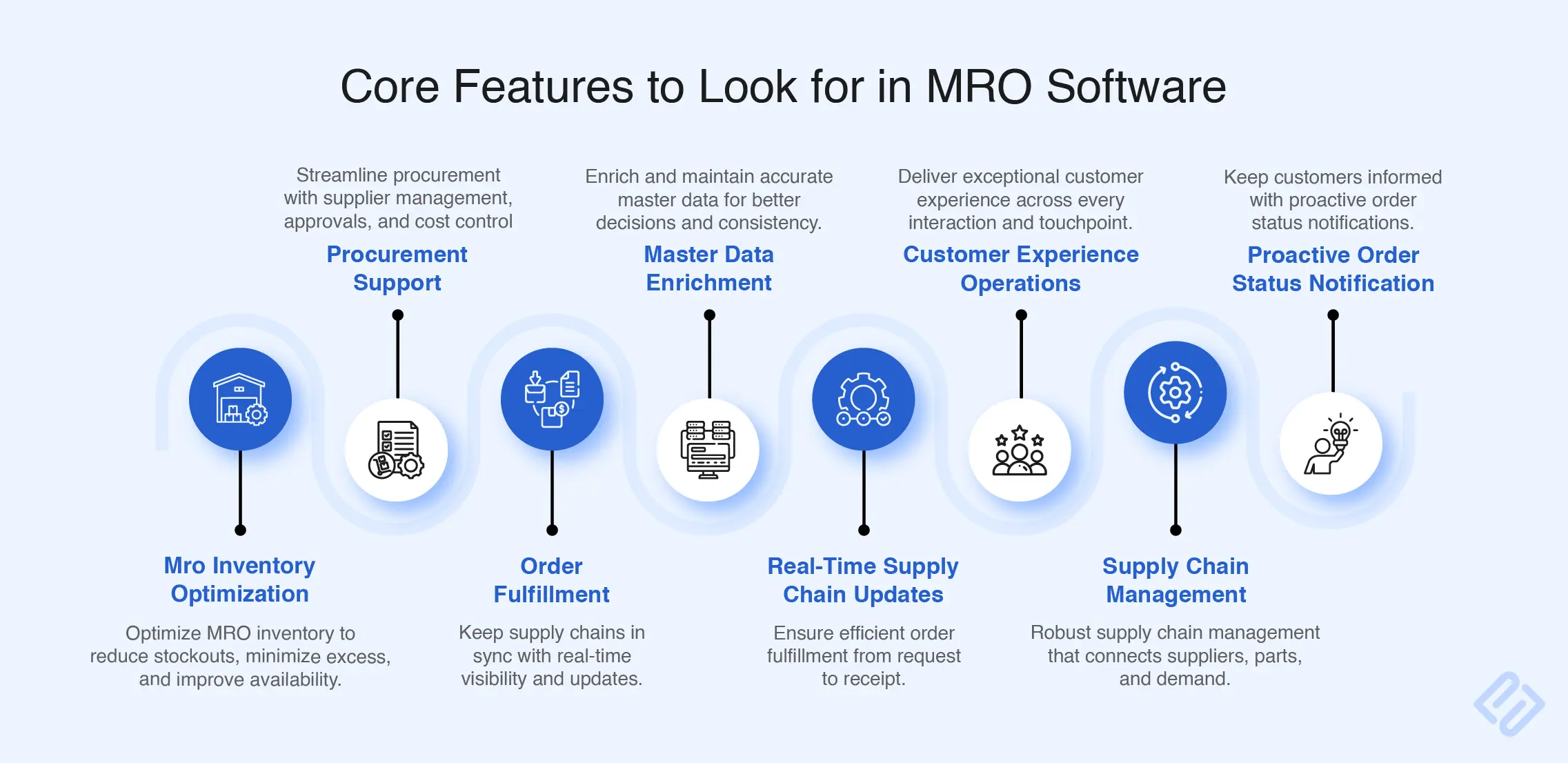
3. Compliance Management
Compliance is one of those areas that most operators struggle with. Regulations are constantly evolving, and keeping up with the requirements can become a job on its own. The challenge grows even further when the process is manual.
This is why regulatory compliance should be one of the core capabilities rather than nice-to-have features. They are deeply tied to how operators work on a daily basis.
There is plenty of room to make compliance management less burdensome. Record keeping, document storage, traceability, and similar processes can be better handled with software.
4. Planning & Scheduling Options
Planning is not something that exists on its own. It depends on inventory, maintenance, available manpower, and several other connections. Scheduling has the same problem. It works when teams and data are aligned. If procurement, maintenance, and inventory management processes are disconnected, planning is less reliable.
Look for how well those features connect with planning and scheduling. Performance, historical data, and maintenance interval can be useful inputs.
5. Integrations Features
Modern MRO platforms function as part of a broader digital ecosystem. They enable smooth data flow across the organization.
Integration with ERP and financial systems provides real-time visibility into maintenance spend. Links to OEM portals ensure that teams are working with the updated documentation.
This approach completely eliminates the fragmented mess that has historically plagued aviation IT environments.
Why Legacy/Manual Approach may Cost You More Than You Think
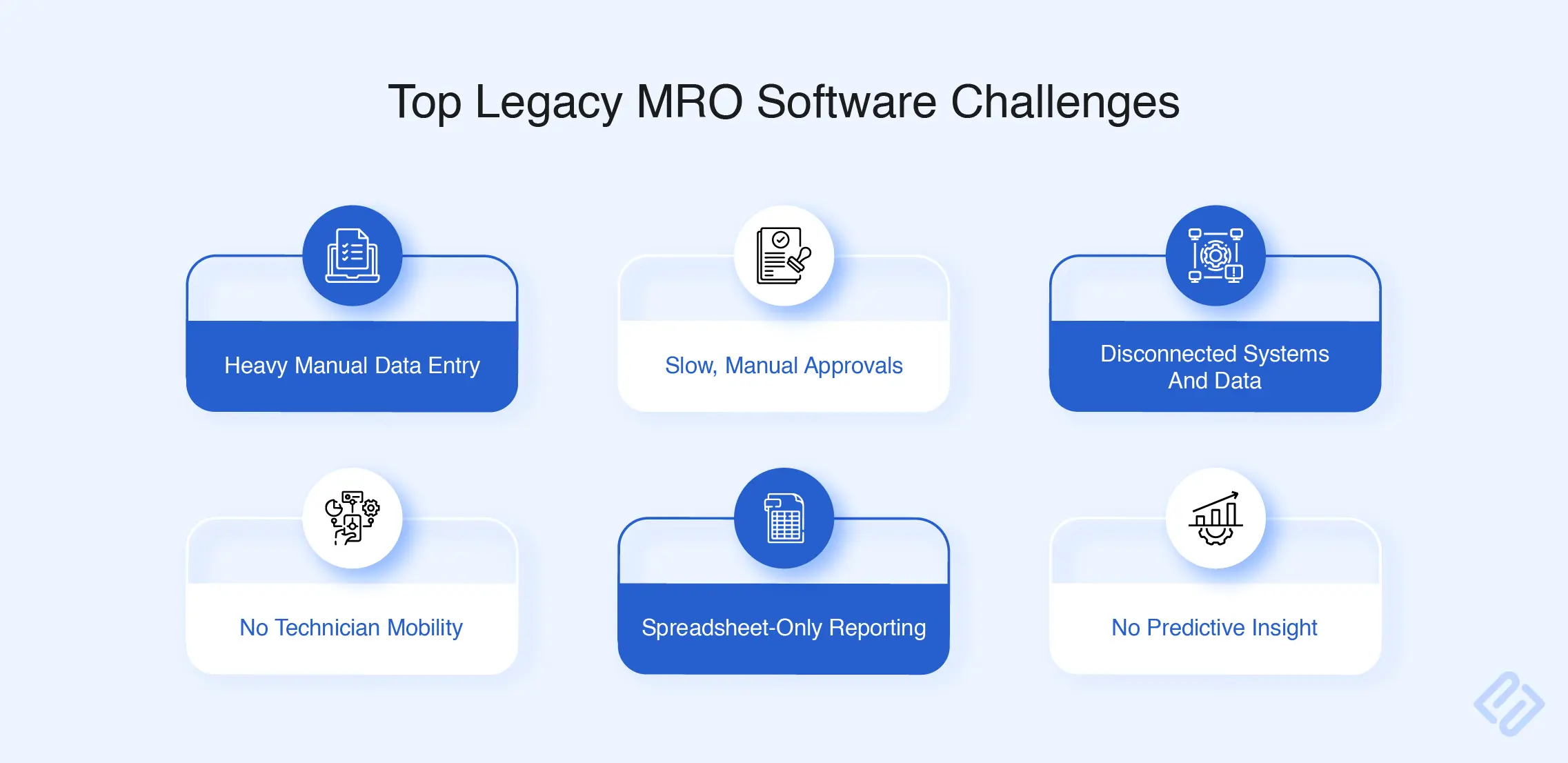
A single modern narrow-body aircraft floods up to 20 TB of data per engine per flight hour. Manually handling this data is a big challenge. The real problem is that much of the aviation, more specifically, the MRO industry, still runs on spreadsheets.
Plus, data migration is not like any other industry due to strict regulatory needs. The biggest problem with the legacy approach is that operators don’t have the real-time visibility of their data (or crucial information).
Workers waste hours manually typing paper work orders, inventory counts, and maintenance logs into outdated interfaces, which causes frequent typos, missing part numbers, and massive approval delays.
Because procurement, inventory, and maintenance departments use disconnected systems, teams never have a single source of truth, resulting in accidental part shortages and field technicians who cannot access equipment history on-site.
Furthermore, leadership is left making blind decisions because the software relies on static spreadsheets, offers zero predictive power to prevent machine failures, and cannot accurately calculate the total cost of ownership for assets.
Evaluation Criteria for Operators
When selecting a product, evaluate fitness for purpose, scalability, usability, and integration capability. Map these benchmarks to your actual needs – whether Saas or custom built. These checks should be the baseline for evaluating your product for your operations.
Don’t pick just because it is trending
Do not buy a SaaS product just because it is trending, or your rivals use it—copying the competition is a terrible reason to pick an MRO digital system. Focus on the actual mechanics: look past the basic, generic features and find the highly specialized tools built for your specific business. If a standard subscription model cannot deliver on those crucial, niche requirements, figure out exactly what you are leaving on the table by passing on custom software.
Scalability is non-negotiable
A system built for ten operators today must be capable of absorbing sudden growth tomorrow without failing or slowing down. Achieving that level of stability requires deep engineering expertise across both technology selection and structural architecture. When you are evaluating a solution, this structural integrity should be your baseline requirement.
Choose product which is “usable”
When people hear the word "usability," they usually picture a clean layout or a simple interface—but it cuts much deeper than that. Usability has a direct chokehold on productivity.
The more hostile and complex a system is to operate, the more it demands an elite expert to run it, which paradoxically drives regular engineers back into their shells. They will actively retreat to familiar manual processes, choosing the safety of an old-school spreadsheet over fighting against a broken, frustrating digital maze.
Evaluate Integration
You cannot build every single micro-service from scratch—frankly, no smart business owner does. When you hit those limits, integration becomes your lifeline.
If you suddenly need to connect your system into your finance operations tomorrow, a well-thought integration framework saves you from having to tear down the entire product and rebuild it.
How MRO Software Needs Differ for Small Operators and Large Teams
In modern day, the common framework looks something like this:
“Once an MRO team grows beyond 50 people, regular software and basic apps doesn’t align with the business needs. Look at it this way: if 10 of your best engineers are wasting 2 to 4 hours every single day doing paperwork by hand, that could be executed with software in a few minutes, you are losing money. For bigger teams that have their own specific way of doing things, building your own software is the way to keep growing.”
— Tanmay, CEO at Prioxis
For small operators, cloud-based solutions are practical options. They need minimal customization. Larger teams and enterprises grapple with an immense amount of data. Nine times out of then, they go for precise-fit systems which we also call “custom build.”
This is the phase to decide whether to build a custom MRO software or buy an MRO SaaS Solution, or customize an existing platform.
Off-the-shelf is the shortcut, letting you hit the ground running on day one. But if your operations don't fit into a standard mold, generic software should not be the go-to option.
Custom software is too much expensive. It could be 5-10X times the cost of the SaaS product. But they give you complete control over every feature.
Customizing an existing is an option between these two extremes. It provides a balance, allowing you to use your existing foundation.
The right choice depends on factors such as:
- Operational complexity
- Budget and timeline
- Availability of in-house technical expertise
- Long-term digital strategy
If you're figuring out, you can skip the guesswork by using MRO buying guide. It highlights effective software procurement process, features to look for in a modern MRO system, with some common mistakes to avoid while building or buying new software.
Is the Modernizing a Legacy Application a Good Idea?
Rather than replacing all at once, most organizations decide on a phased approach for aviation MRO modernization. Migration experts break down the entire journey into manageable stages. For example, a standard approach may involve migration in the first phase, then supply chain integration, followed by advanced integration such as telemetry & ACARS, OEM digital twins, machine learning, and predictive maintenance.
Here are the data practices we recommend keeping at the center of your strategy:
- Begin with data assessment and cleanup. Migrating this data “as is” only carries problems into the new system.
- Map each data point—from maintenance history to parts inventories.
- Running trial migrations to identify issues.
Introducing a new system changes how work and report. These changes need to be clearly communicated, not just in terms of what is changing, but why it matters. Hands-on sessions, documentation, and ongoing support help users become comfortable with the system.
Costs and ROI of Aviation MRO Software
Now here comes the biggest question: what is the cost of custom MRO software for aviation. If you are looking for a detailed module, phase, scope, and engagement-wise cost, refer to custom MRO app cost guide.
In short, the cost varies. It depends on one’s needs. If it is an enterprise-grade project, you may need to spend more than 100k, 5-10x of basic application development cost.
Plus, if it is to be integrated with or in a broader ecosystem consisting of an array of services, the cost will go up. In general, they don’t run in isolation. Custom solutions are only viable when you have to connect with systems such as ERPs, databases, and external services.
Scalability and performance play a big role. These systems are mainly created to handle hundreds of thousands of operational parameters simultaneously.
A single next-generation aircraft logs up to 400,000 operational parameters simultaneously. To put that into perspective, a single Boeing 737 generates approximately 20 Terabytes of data per hour of flight. To manage such kind of operations, you may need to invest in seven-figure, on which we have discussed in detail in MRO software development cost.
Coming to the ROI, a good CMMS/EAM system can help you measure metrics such as reduced overtime. To calculate ROI, organizations typically:
- Compare current operational costs with projected post-implementation costs
- Estimate time savings and productivity improvements
- Quantify reduction in delays, errors, and compliance risks
- Evaluate long-term gains from improved decision-making and data visibility
Summing Up
We are not talking about replacing spreadsheets with random software, but, providing a unified nerve center that helps them get critical information in a few clicks instead of a frantic hour-long search for those who are involved in your business. Ironing out these basic operational wrinkles is a practical path of modernization.
Leaving repetitive tasks in human hands when modern systems can completely wipe out human error is like racing a bicycle against a jet engine. This digital foundation enables the most critical evolution: predictive maintenance.