


Summarise with AI:


In our aviation software development projects, we hear time and time again that clients have invested in premium software, yet legacy and manual options are less painful to execute for several key tasks than their so-called 'digital' solutions.
Interestingly, we have observed the software was the problem in every instance. The problem was in their procurement strategy.
Many aviation companies simply follow what big players do. They buy popular platforms without realizing that their needs and business requirements are fundamentally different. In B2B, one small 'good enough' decision can turn into productivity and efficiency kill.
They are bringing a cannon to a knife fight. To navigate you these challenges, we have a written this mini guide for the founders looking to elevate their infrastructure by adding a new software for their daily operations.
TL;DR
- Don’t run after the software with too many features. Number of features should not be the sole metric to validate its effectiveness.
- Look for at least these features inventory visibility, integration readiness, and reporting depth.
- If data and workflows are chaotic, or you’re planning a MRO data migration, the MRO rollout could be far less effective than you anticipated.
- Before finalization, know total cost of ownership, which may include post-purchase investment in training, and support, etc.
4 Steps for Effective Software Procurement
The moment you hit search for “how to procure an enterprise software for my MRO business,” you probably have got hit with a total tidal wave of noise. It’s known as information overload.
When you give someone over information, you effectively give them none. In this high-stake decision, you must know how to rigorously evaluate the buying decision.
Here we outline a step-by-step guide to help you strategically procure bespoke aviation MRO software to bypass costly mistakes arising from strategic misalignment.
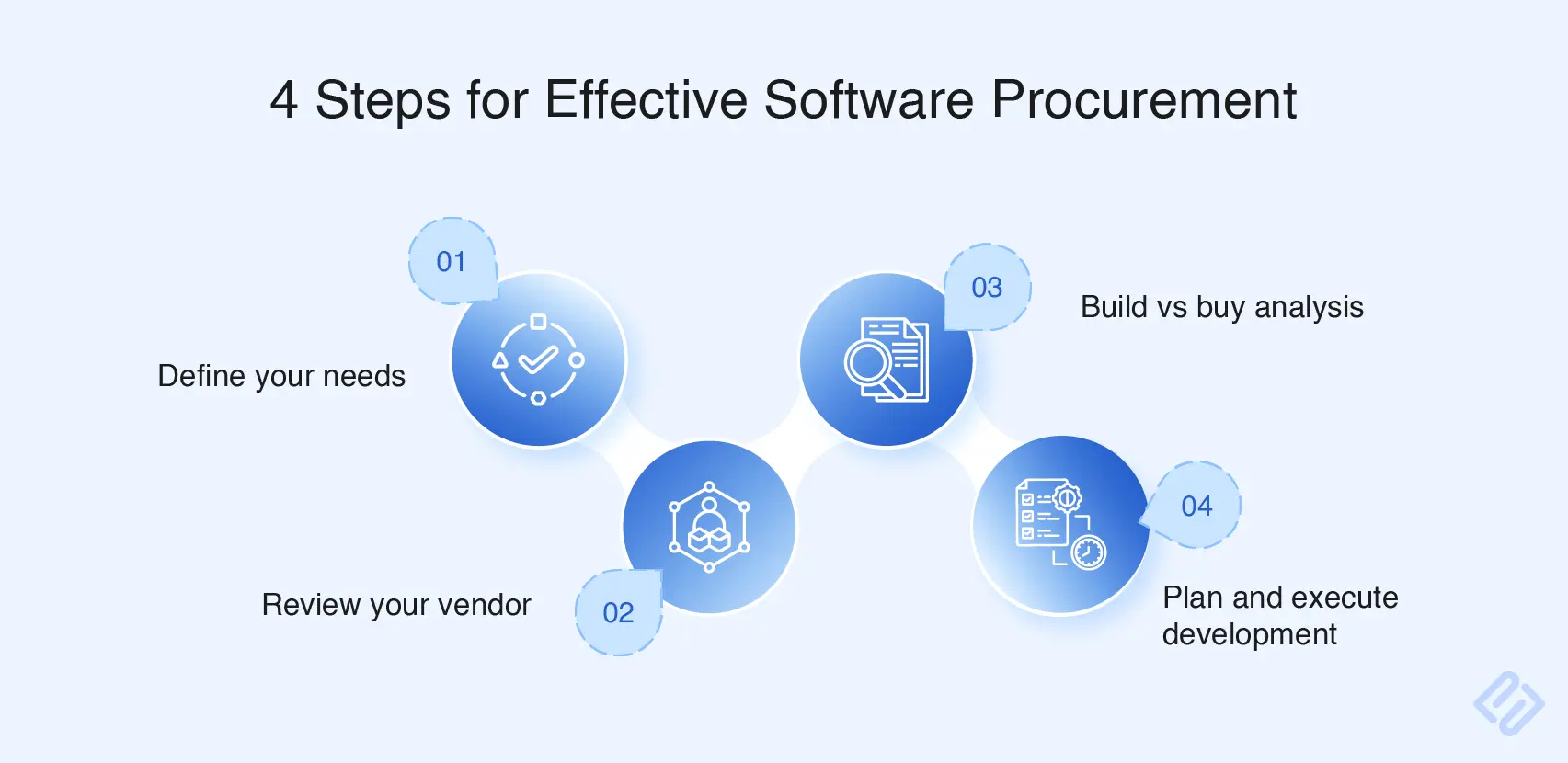
Step 1. Define Your Needs
CIO documents some “famous ERP disasters” where companies implemented systems without defining their needs.
In several of these projects, organizations chose a big-name, then discovered mid‑implementation were more complex than expected. Therefore, define your needs first before making any decision. In this context, you can document your objectives such as:
- I want to reduce downtime.
- I want better visibility in these areas in my business.
- I want to improve my maintenance mechanism.
- I want to reduce the efforts in compliance related tasks.
- I want to automate these processes.
- I want more reliable reporting and so on.
If you document these things clearly, you can make better ‘buy vs build’ decision. Later, this is going to help decide on ‘must-have’, and ‘nice-to-have’ features.
Step 2. Choose Between Agency or Dev
Go Solo If: You are building a minimum viable product (MVP). This is simplest version of your product developed to validate your idea. Plus, it is a budget-friendly option. Look for solo developers but budget extra time to vet their actual skills. If you are not experienced with hiring process and are at capacity to review day-to-day work, skip this route, and look for a software firm.
Go Agency If: Your product is complex. Plus, you think it is a task for a for a cross-functional team (designers, coders, managers). Pay the premium for a software development company. It gives you a long-term stability.
Step 3. Review Your Vendor or Potential Client
If you're looking at a product-based business, Capterra, G2, Product Hunt, or the app store are the go-to places to see what people say about the product. You can further drop a question on social platforms such as Reddit, X, and niche groups for unfiltered opinions.
For service companies, it’s a bit different. Spend time on off-page channels such as Clutch, Google Reviews, plus if they have got recommendations from existing customers on any of the social platform such as Reddit, X, or LinkedIn, to evaluate their work. Furthermore, you can check if they have posted some real work on their website.
Step 4. Build vs Buy Analysis
You don’t need to build every software from scratch. If you can buy the same app your competitors use, why go for custom development. But it makes sense, when you have niche issues.
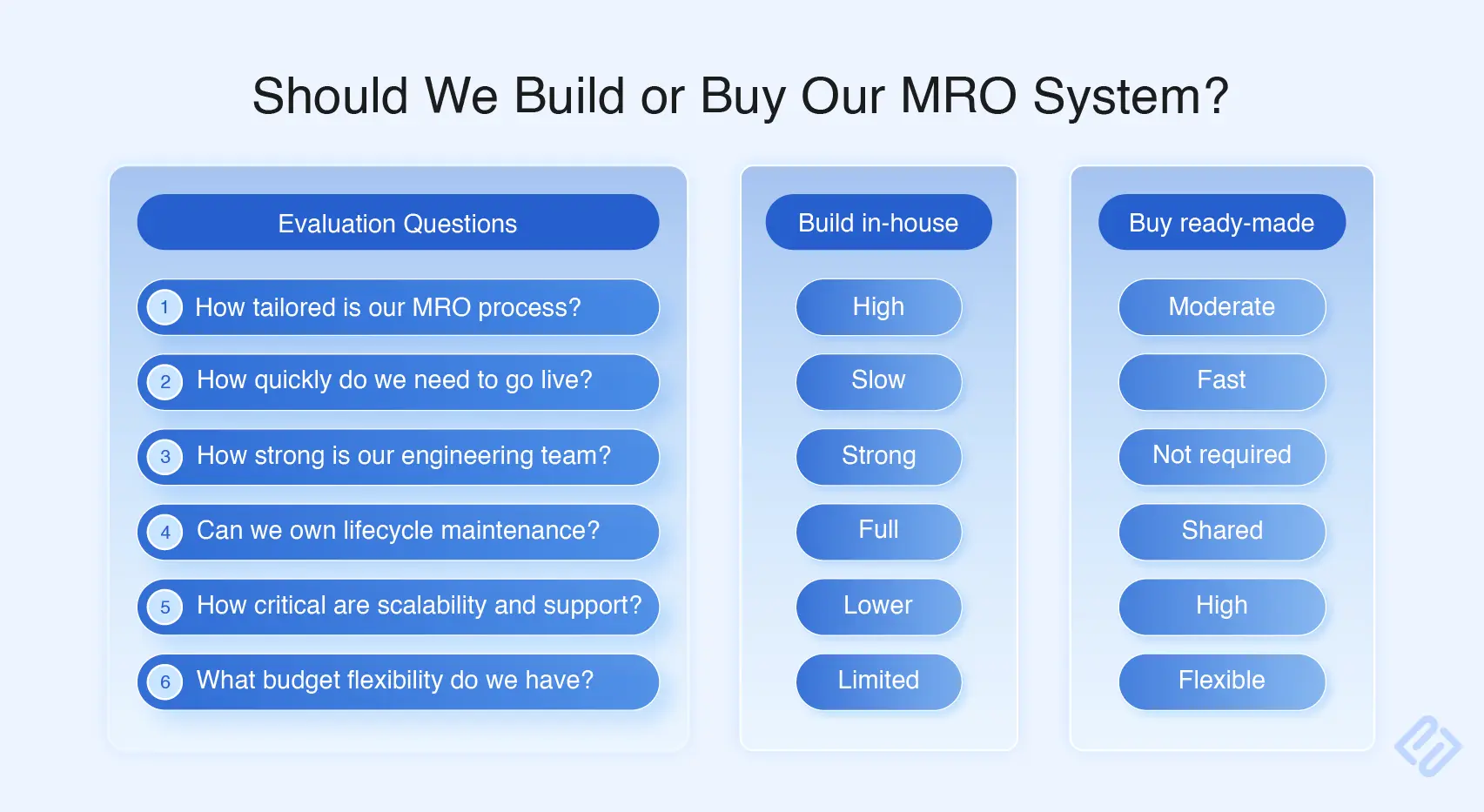
Major teams make mistake when they treat it as a cost question, instead of a strategic question. Below are the factors to look for to make a strategic decision.
- Cost analysis but make sure you are thinking long-term.
- Buying means, you are running faster, sometimes in months, but if doesn’t align with workflows, it might not worth your investment.
- The readymade products have the same level of customization features you looking for, buying is the right decision.
- Custom product can evolve and scale without pain, but it requires a technical team which you can outsource if it is sporadic task.
The most important one is if the product you are using gives you a competitive edge. In most cases, the answer is custom development.
What a Modern MRO System Must Support
In 2026 running a business without AI is like trying to win a race on a bicycle against sports cars. This technology is incredibly – millions, and sometimes billions of times faster than humans – in terms of how fast it processes data.
We always urge our partners to not miss on AI features. However, when it comes to MRO, this is one of those industries where adoption is really tough. Compliance issues and a few other deep-rooted reasons make change slow.
We dug into McKinsey’s "MRO 2.0" report. It outlines what leaders are planning, illustrating what modern MRO software must have.
1. Predictive Maintenance
Predictive maintenance reduces unwanted surprises. It uses technologies like machine learning and artificial intelligence to spot trouble early. But you can only get this predictability if your whole ecosystem is AI-ready. Having AI built into the core of your business is completely different from just slapping it on as a random add-on.
2. Business Intelligence
Technically, these words can mean different things depending on who you ask in tech. Jargon aside, I mean business intelligence here analytics and data-driven decision-making. A research shows that coordinated AI models handle data sorting with over 97% accuracy, leaving human experts in the dust when it comes to speed and precision.
Smart, data-fed intelligence is no longer optional for modern operations. But there is a catch: an AI tool is only as smart as the fuel you feed it. Companies everywhere are realizing that messy, scattered records are their biggest roadblock, and the MRO sector faces this exact same uphill battle.
3. Tech Driven Compliance
No matter how advanced software gets, staying on the right side of the law remains a massive mountain to climb in heavily regulated sectors. Every wave of new tech tends to bring a fresh layer of red tape with it.
This is where smart systems step in to smooth things over. By using connected databases and ironclad rules built directly into the software, it automatically plugs the documentation gaps that usually trip people up during audits. Ensuring your platform handles these regulatory burdens automatically is a non-negotiable trait for any operation trying to thrive today.
The Must-have Features Before You Buy
Every company or product builder claims they can make your life easier with their digital products, with perks like reduced cost and better visibility across business operations. If you are not sure about your requirements, create the clarity first. To fast track it, reach out to an MRO consulting firm, they bring years of experience, preventing from costly mistakes.
If you onboard an external expert—who will need deep knowledge of your operations— make sure these features must be integrated into your app.
1. Integration Readiness
A modern MRO system does not live on an island. It connects to your ERP. It connects to tools for PRs, and POs; to your inventory and procurement process; to sensors, SCADA or BMS; and to your analytics stack.
2. Inventory intelligence
AI in inventory cut wastes and boost efficiency, as reported by of executives in industry reports. Plants that have gone down this route with AI‑driven tools report 15–30% less inventory value tied up and 20–40% fewer last‑minute emergencies because the system keeps adjusting reorder points in the background.
3. Reporting and Decision Support
The system should let you pull, without IT help, accurate reports on:
– work orders completed and pending
– repeated failures by asset
– labor hours by technician
– parts and materials consumed
On top of that, it should support filtering and grouping so you can check patterns instead of staring at totals. If the software makes it hard to get these reports, it will not help you run maintenance better; you’ll end up back in spreadsheets.
Security, scalability, and vendor support
The system should sign people in through SSO,and let you control access by role. It should log who did what and encrypt data. It should already be running in bigger plants than yours, with more assets and users, without slowing down or breaking when they update it. There should be a support team you can name, and a simple way to train new people and new sites without rebuilding everything.
A Practical Evaluation Framework
Test software against the reality. A practical evaluation should cover four dimensions.
- Strategic Fit
The first question is whether the software fits the organization. What does this mean? Let’s say there is a plant A and B. The first one focuses on preventive and reliability-centered maintenance and second one is service-heavy organization. Does the same workflow work for both? No. That is why buyers should score vendors against their specific checks.
- Data Readiness
Prior to any purchase decision, assess these things: asset master management, classification of spare parts, vendor history, maintenance history, and dependency on system integrations. It is more convincing if a potential vendor talks about migration and governance than about data cleanup.
- Usability Under Real Conditions
Demand for scenarios to be tested. Ask vendors to show a preventive work order, an emergency part shortage, mobile inspection, a reorder, and compliance reports using processes similar to the actual business process.
This is important since most systems appear easy to use when demonstrated in a nice presentation but are difficult to use when put under stress. The scenario test must include planners, technicians, store staff, and supervisory staff.
- Total Cost of Ownership
When you make investment, think beyond initial cost. Total cost of ownership or TCO involves cost such as hosting, maintaining, updating, user support, downtime; also known as post-launch or operational costs.
Itemize all the initial aviation MRO development costs or licensing, cloud, on-premises installation cost, migration cost, and training. Then there are recurring costs for maintaining, upgrading and security patching.
Common Buying Mistakes
Over and over, teams pick an aviation ERP that’s built for airlines or large MROs, then realize six months in that 60% of the screens and modules are dead weight. They live with complex Salesforce-style workflows, 1000-field setups, multi-business modules, and a steep learning curve for a small team that just wanted quoting, inventory, and simple maintenance tracking.
1. Buying a massive system that is overkill for your small team
2. Treating the initial data migration as a minor IT task
3. Picking clunky software because you think workers will just adapt
4. Focusing on a low sticker price while ignoring hidden add-on fees
5. Choosing a tool that does not match how the hangar floor actually operates
6. Selecting a system with poor reporting and difficult data exports
7. Falling for a complex customization process that never actually ends
Questions to Ask Vendors Before Signing
The quality of the buying decision often depends on the quality of the vendor conversations. Buyers should push beyond canned demonstrations and ask for direct, operational answers.
- How does the system handle preventive maintenance scheduling across multiple asset classes?
- What happens when a technician needs to complete work offline and sync later?
- How are spare-parts reservations, substitutions, and stockouts handled?
- What integrations are already available, and which ones typically require custom work?
- Which maintenance KPIs and audit reports are available out of the box?
- How long do implementations usually take for organizations of similar complexity?
- What level of onboarding, support, and change-management guidance is included?
Final Thoughts
The best MRO solutions don't include every promising feature possible. When evaluating software, prioritize platforms that handle real-world operational challenges like inventory discipline and audit readiness. That's why we built AI-powered aviation MRO platform to focus on what is important for your operations. Book a demo to see it in action.