

![The Real Cost of Building a Custom Aviation MRO Solution [in 2026]](https://cdn.prioxis.com/blogimages/1779102275574_The%20Cost%20of%20Building%20Custom%20Aviation%20MRO%20Solution123-02.webp)
Summarise with AI:



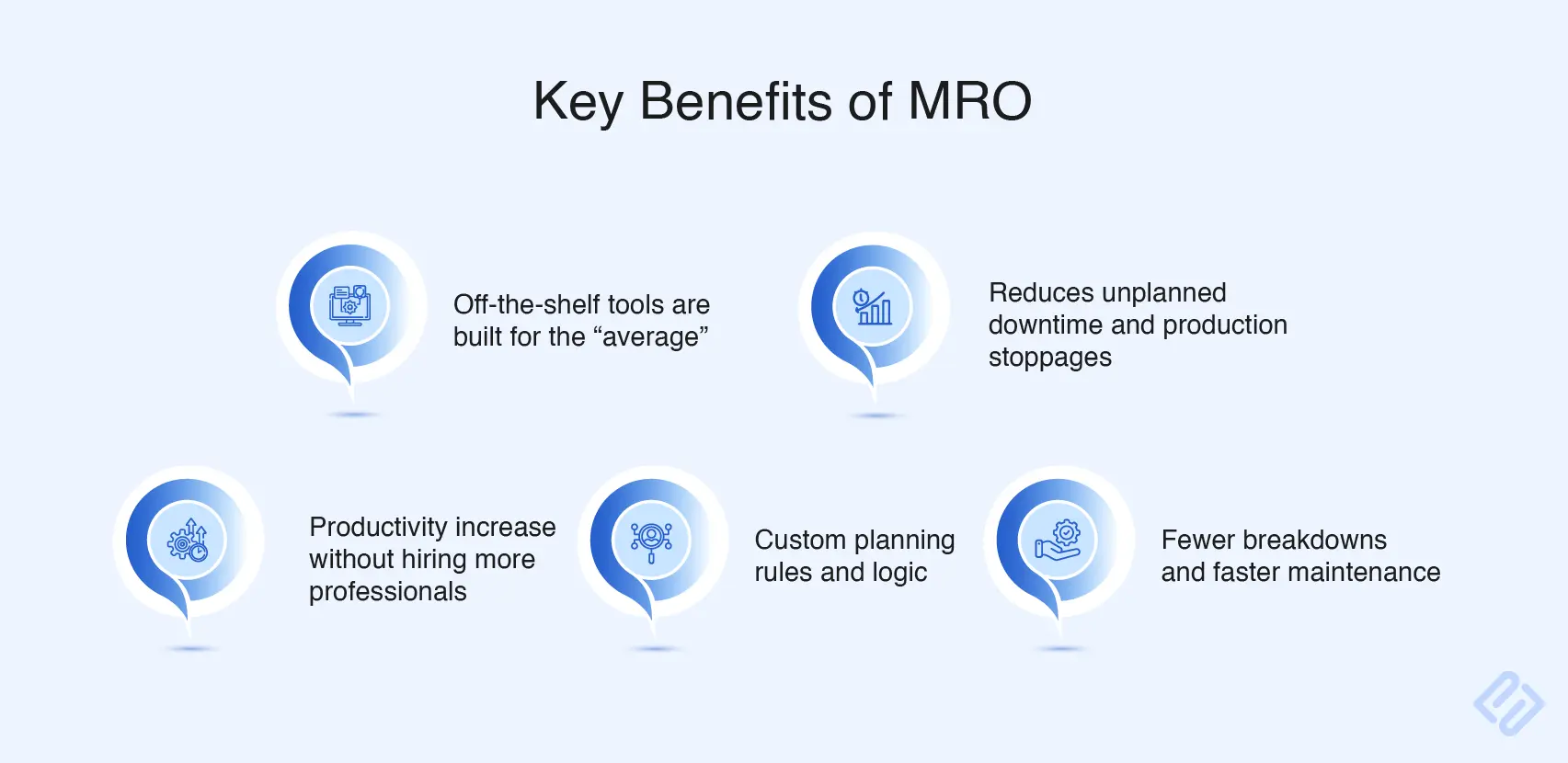
Maintenance that once was predictable, now taking on a life of its own. The impact is subtle but serious: soaring maintenance costs. In this climate, having “good enough" maintenance software is becoming too expensive. Given today’s reality, custom aviation MRO software – specialized and artificially intelligent – is far more essential than they were three years ago.
For large, distributed maintenance teams, the pressure is ever shaper. Generic or off-the-shelf solutions limit planners and technicians. In our experience, long-term costs are greater. In our blog “why generic MRO platforms are not suitable for large team,” we have discussed in detail.
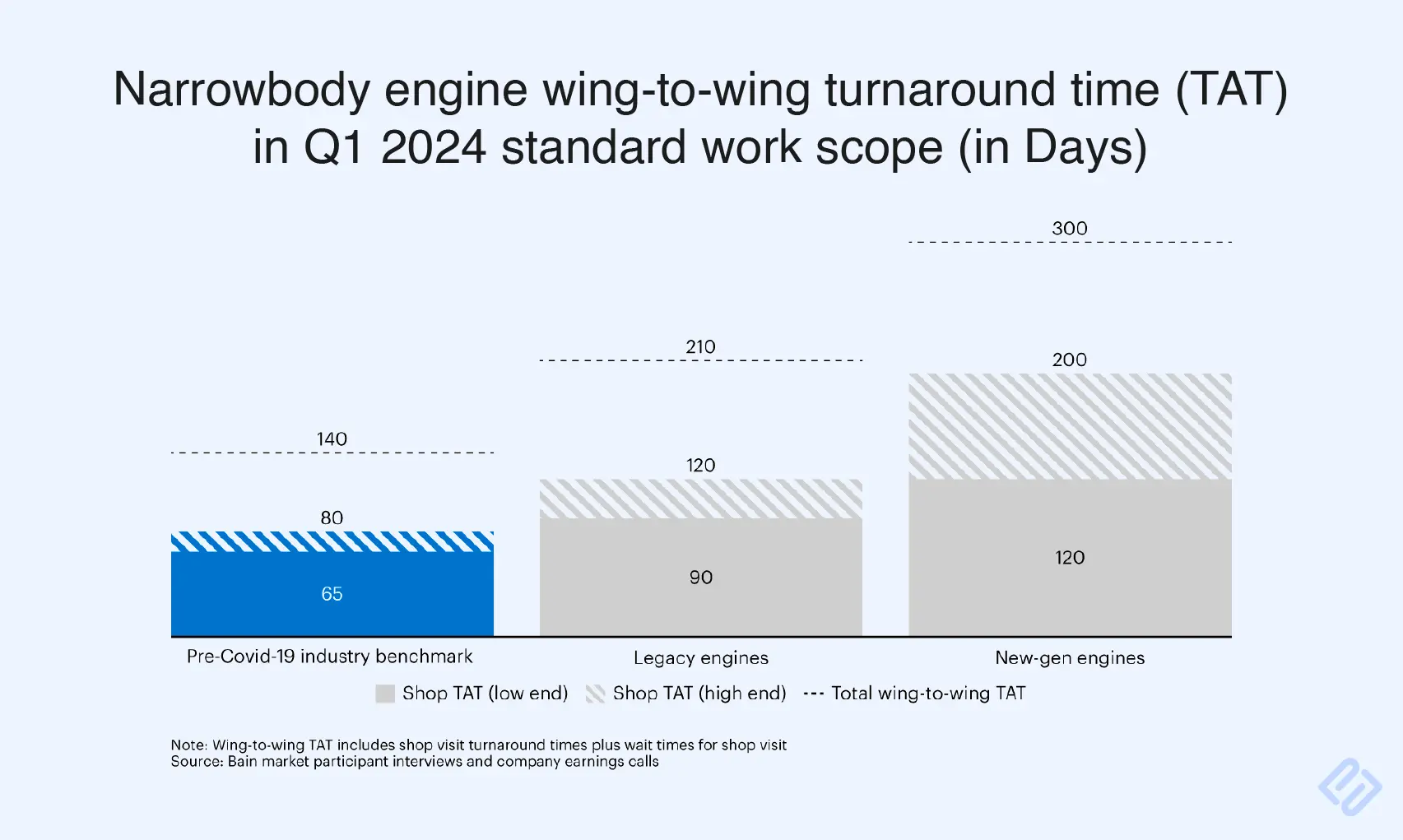
Aircraft are spending far more time on the ground than airlines ever planned for, Bain reports. Today, only 6% of MROs have integrated digital and analytics at scale. Engine shop turnaround times are now about 35% higher for legacy engines. For newer‑generation ones, the turnaround is much higher.
A plethora of companies – flight departments, commercial airlines, charter companies -- use stone-age systems incorporating Excel sheets, legacy tools, and generic ERPs to track and maintain.
Custom software development, without a doubt, requires heavy funding upfront. But it is often found to be more cost-effective in the long run. Besides incognito perks such as lean operations and high productivity, custom software potentially yields better ROI over 4 to 5 years. When you look at the day-to-day, the ROI is clearer for companies with large teams.
If your operational processes are hindered by excessive manual work, multiple disconnected and old systems where data is chaotic, it’s time to build bespoke software.
In this article, we will break down how much it costs to build an MRO software in 2026, outlining what drives the cost and comparing it with off-the-shelf software.
Get a Custom MRO Budget Estimate
Turbulence of Transformation in Aviation Industry
Until a few years ago or before the arrival of generative AI, creating custom software was restricted to an "elite" group of specialized developers and large organizations with massive budgets.
The concept of building custom software was absent from the strategic consideration of many tech and non-tech business owners. Then AI started disrupting product development and standard operating procedures.
Now it has become a question of survival. The gap between an AI-native company and those still using pen and paper is growing by leaps and bounds. The question is simple. Can you survive in a modern environment?
Custom Software Ideas are Abandoned Before Building
Even though business leaders understand how important it is to modernize legacy MRO systems, the decision to build custom software, more often than not, fails to take shape.
Our team at Prioxis sees this pattern on repeat. Organizations blame their new system time and again for this mess, but they fail to understand that they've moved a broken engine into a new car. If you don't validate the data before going live, you are technically responsible for the ineffectiveness of the new system.
— Lead Migration Expert, Prioxis
When Should You Consider Custom MRO Solution
- Mid-Sized MROs: If you still run your operations on an Excel sheet or on too bloated and expensive software, which you can’t customize. The single issue within a datasheet forces you to spend the whole day.
- Data-Drowning Managers: You have a hundred TBs of data to manage, and the software (or internal system) buckles under the load. You want predictive AI to make data analysis easier.
- Hyper-compliant organizations: Keeping up with compliance is a herculean task. Modern systems have the ability to incorporate telemetry data from modern engines and automatically produce compliance reports.
- Advanced Air Mobility (AAM): You are flying 2026 tech, but your maintenance software was built in 199x?
Just because everyone is using that massive enterprise software and it’s the industry standard, you shouldn’t waste money using a sledgehammer to crack a nut when custom software can do a better job. The bespoke solution or software is built to fit your business, align with your internal processes.
Custom Aviation MRO Cost Breakdown
1. Core Modules
A production-ready aviation MRO platform typically requires these functional modules.
| Module | Features | Estimated Cost |
|---|---|---|
| Work Package & Task Card Management | Digital work orders, multi-shift assignment, sign-off workflows | $25,000–$45,000 |
| Hangar & Line Maintenance Planning | Bay allocation, manpower scheduling, TAT tracking | $20,000–$40,000 |
| Parts, Rotables & Tools Inventory | Serial/lot tracking, shelf-life, certifications, bin locations | $30,000–$55,000 |
| Vendor & Repair Order Management | RO lifecycle, TAT, cost, warranty tracking | $20,000–$35,000 |
| Component Lifecycle & LLP Monitoring | Automated due calculations, threshold alerts, status tracking | $25,000–$50,000 |
| Digital Logbooks & Tech Records | Airworthiness-grade records, audit-ready documentation | $20,000–$40,000 |
| Compliance, Audits & AD/SB Tracking | Regulatory checks, audit trails, airworthiness directives | $25,000–$50,000 |
| ERP, Finance, HR, Flight Ops Integrations | APIs to SAP, Oracle, Ramco, HR systems, flight ops, OEM portals | $40,000–$80,000 |
Please note: Just a heads-up; these numbers are estimates. Plus, I assume your development team is from India where development costs are between $25-$45 an hour. And you’d hire 8 to 12 engineers. I've assumed the whole development time to anywhere from 12 to 18 months.
2. Cost Breakdown by Phase
| Phase | % of Total Budget | What It Covers |
|---|---|---|
| Discovery & Planning | 10% | Requirements, process mapping, compliance research |
| Architecture & Design | 5–10% | System design, UI/UX, data models, aviation workflows |
| Engineering (Core Build) | 65% | All module development, APIs, backend, mobile |
| QA & Compliance Testing | 20% | Functional, security, aviation-standard validation |
| Deployment | 1–2% | Cloud setup, go-live support, initial migration |
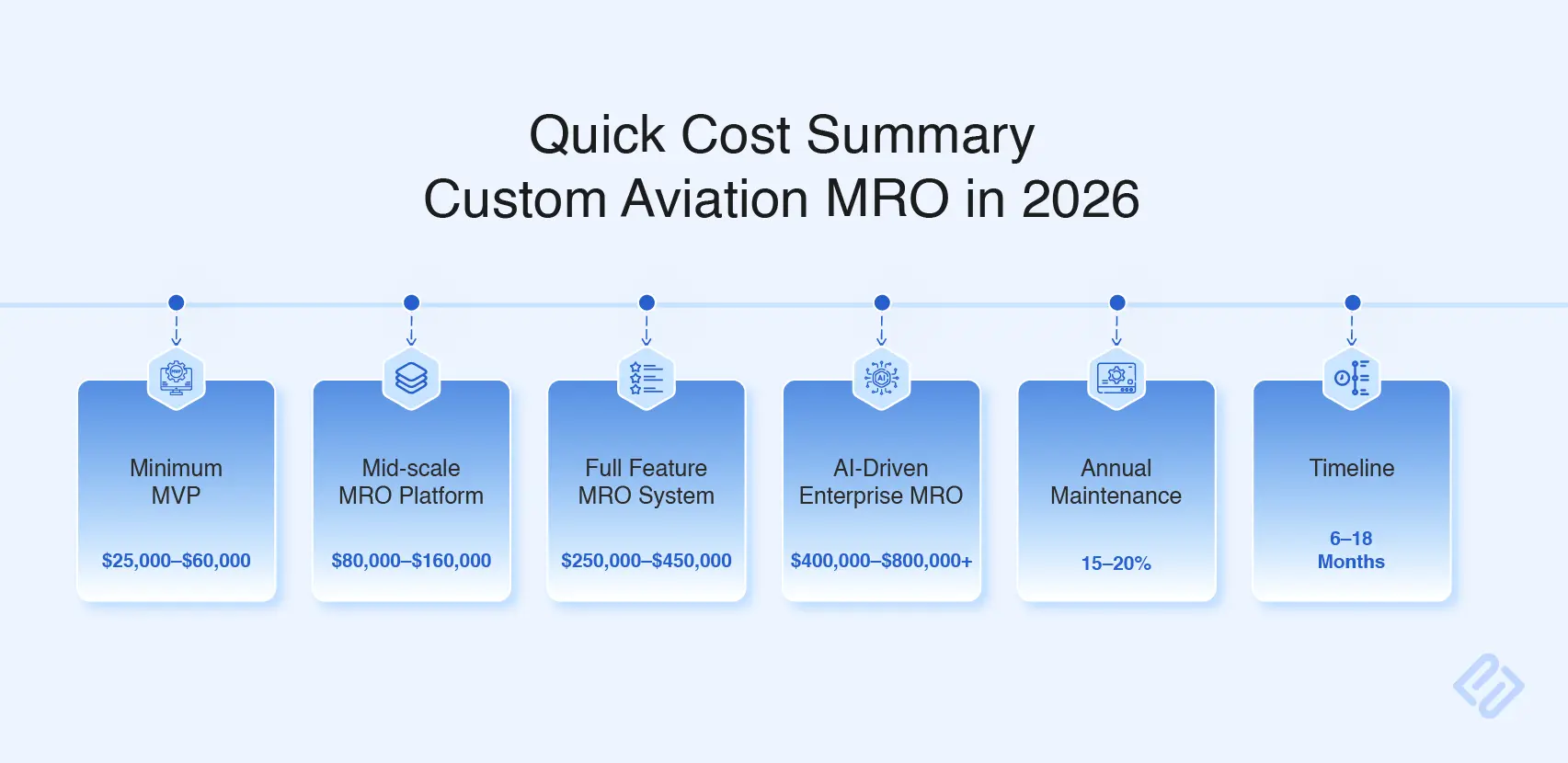
| Annual Maintenance | 15–20% of build cost/year | Patches, feature updates, compliance changes, infrastructure |
For a $300,000 build, expect $45,000–$60,000 per year in ongoing maintenance costs.
3. Cost Breakdown by Scope
This is where most founder estimates go wrong. They see a "$80K aviation software" quote and assume that covers an enterprise MRO platform. It does not. Here is what different scope levels cost:
| Scope | What You Get | Team | Timeline | Realistic Cost |
|---|---|---|---|---|
| MVP / Proof of Concept | 2–3 modules (e.g., work orders + basic inventory), no compliance layer, no integrations | 3–5 people | 3–5 months | $25,000–$60,000 |
| Phase 1 Product | 4–5 modules, basic compliance, limited integrations (1–2 external), mobile-ready | 6–8 people | 6–9 months | $80,000–$160,000 |
| Full MRO Platform | All 8 modules, full compliance layer, ERP integrations, multi-base, multi-role | 10–14 people | 12–18 months | $250,000–$450,000 |
| Enterprise-grade with AI/predictive | Full platform + predictive maintenance, IoT, ML, real-time analytics | 12–18 people | 18–24 months | $400,000–$800,000+ |
4. Cost Breakdown by Engagement Models
You can choose among three primary outsourcing structures; no model is universally superior.
A fixed-price model is one of the most popular approaches for those from non-technical backgrounds. You and the developer or agency agree on a fixed price. But if you're not sure how big the project will be or how long it'll take, this isn't the best way to go. The catch with a fixed-price model is that changing your mind can be expensive.
You can choose the time and materials (T&M) model if you clearly know how much time it is going to take. You will pay for the hours worked at the agreed rates. It is better than a fixed-price model when you have a project with evolving requirements. In other words, when you are experimenting, time and materials is a strategic option.
The development cost starts at $20/hour per developer in India and $40/hour in Eastern Europe. The disadvantage of T&M is that knowledge transfer and rework may not be smooth.
There is another option: bringing in a dedicated team. This team works remotely or in a hybrid manner. The team exclusively works on your project. They work just like an internal team. Alternatively, you can hire a dedicated manager to handle the workload exclusively on your behalf.
Hybrid (Recommended for MRO): Start with a fixed-price contract for MVP, then transition to a dedicated team.
5. Regional Team Cost Comparison
Where you build has an impact on cost.
| Region | Hourly Rate | 12-Month Full Team (8 people) | Aviation Domain Expertise |
|---|---|---|---|
| USA / Canada | $80–$150/hr | $1.2M–$2.4M | High (but expensive) |
| Western Europe | $70–$130/hr | $1.1M–$2.0M | High (especially Eastern EU) |
| Eastern Europe | $40–$70/hr | $640K–$1.1M | Good (Poland, Ukraine, Romania) |
| India | $25–$45/hr | $400K–$720K | Growing rapidly; vet carefully for aviation domain |
| Latin America | $30–$60/hr | $480K–$960K | Moderate |
The hiring cost of an onshore developer from either the US or the UK is between $120,000 to $160,000 annually, while from India, it could cost between $30,000 to $45,000 annually.
Blindspots in Custom Aviation MRO Software You Must Avoid
AirAsia's first attempt to build a custom MRO system in-house with a local vendor failed within three months, due to a fundamental underestimation of the complexity of airline engineering processes.
The company then switched to buying an off-the-shelf system, which itself overran its implementation timeline. This is the norm, not the exception.
McKinsey’s 2024 survey of MRO operators found that more than 80% of respondents consider data limitations to be the most significant barrier to digital adoption.
Hidden Costs of Custom Aviation MRO Software
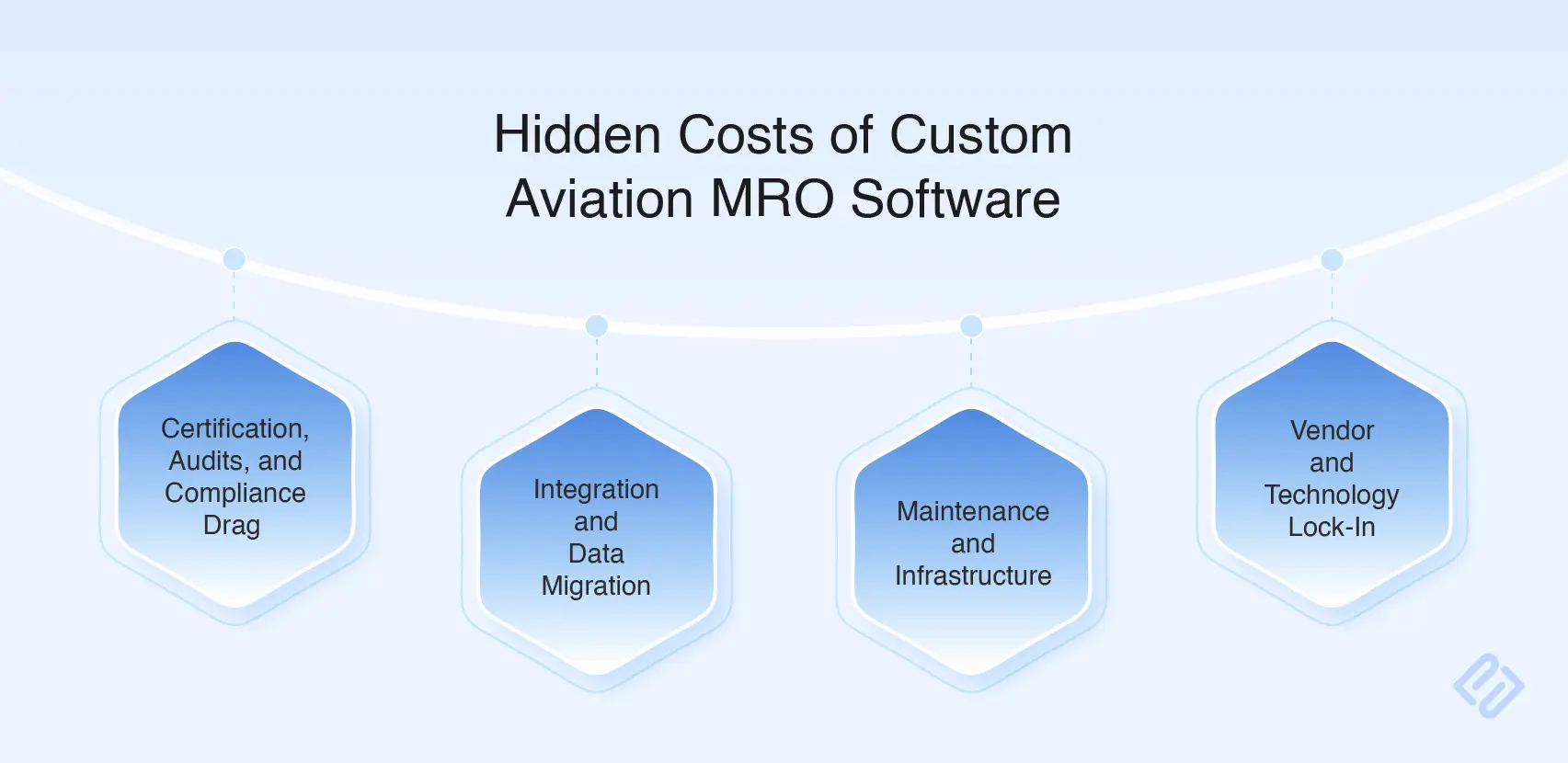
Software development is a part of the process. Data quality, migration, and integration usually add to the cost.
Plus, it is one of the most compliance-intensive and domain-specific categories in enterprise software. You cannot compare it to building a SaaS dashboard or a booking platform.
These items collectively add 30–50% to the headline build cost. Most founders discover them after the contract is signed.
- Data Migration: Aviation data is one of the most sensitive migration challenges in any vertical. A single aircraft's maintenance history can span 20+ years of records.
- Compliance and Regulatory: Aviation software must comply with EASA, FAA, and/or regional requirements.
- Training: User reviews across all major MRO platforms consistently cite steep learning curves. Expensive training and change management are unavoidable costs.
- Third-party Integration: ERP integration is one of the highest-cost line items in any MRO system. If your customers use multiple ERPs, multiply accordingly.
- Maintenance: A $200,000 custom app may cost approximately $30,000–$50,000 per year in maintenance alone.
Common Reasons Custom MRO Projects Fail (and How to Avoid Them)
Custom systems work where they consider aviation practicality and regulation knowledge, while custom MRO systems fail when they do not consider aviation practicality and regulation knowledge.
- Underestimating Documentation Teams under-scope regulatory records, leading to audit gaps and expensive rework. Design data models and workflows around authority and OEM evidence needs from day one.
- Hiring Inexperienced Team Generic software skills miss nuances like MELs, ADs, and component life tracking. Pair engineers with SMEs and embed domain reviews into every sprint.
- Ignoring Training Great tools fail if engineers stick to spreadsheets and legacy habits. Plan role-based training, champions, and phased rollout as core project deliverables.
Get a free consultation with our aviation software experts and receive practical recommendations.
The Bottom Line
A full offshore build calls for a commitment of $250k–$450k, takes 12–18 months to bring online, and carries a $45k yearly upkeep.
An enterprise buys alternative costs $500,000–$2M+ upfront with $150,000–$400,000/year ongoing. The numbers favor building for a SaaS founder selling to multiple MROs, and favor buying for an operator who needs working software within a year.
The deciding variables are your domain expertise, your technical leadership capacity, your timeline, and whether you have aviation-specific developers or partners who understand Part 145, LLP tracking, and digital logbook requirements at a deep operational level.
No amount of generic development capability substitutes for that domain knowledge — and that is exactly why the cost and timeline for MRO software consistently exceeds initial estimates.