

Salesforce Implementation Cost in 2026: Full Breakdown, Examples & Calculator
 Tanmay Soni


Summarise with AI:



Summary: Salesforce implementation typically costs between $10,000 and $150,000+, depending on users, customization, and partner location.
This guide breaks down Salesforce development cost in 2026 by users, customization, licensing, and partner location.
Customer relationship management, or in short, CRM, equips businesses – irrespective of size – to get under the skin of their users or customers. These systems help businesses go the extra mile for the customers. CRM platforms smooth out the bumps born out of limitations in the traditional software or systems.
And implementing a customer relationship management system is one of the ways to address operational bottlenecks.
As a trailblazer in the CRM industry, Salesforce is an all-in-one platform that includes almost everything a company may need for sales, service, and marketing.
However, it is worth remembering that Salesforce does not carry a flat price tag. It’s license costs are fixed. But, Salesforce implementation costs vary from business to business. Below is the direct cost breakdown and the leverage points leaders to know to control the budget.
Cost can go through the roof if you don’t plan it right. This blog takes a clear look at what Salesforce implementation is likely to cost in 2026, and what drives implementation cost up or down.
How Salesforce implementation connects to business growth
Salesforce is one of the most reputed names globally, with over 20.7% global market share as of 2024-25. With suites of tailored tools, it connects marketing, sales, service, commerce, and IT teams with its unified view of customer data, bringing people, AI agents, and external apps together.
It unifies different area of business and team such as sales, marketing and IT. Salesforce makes it easy to handle B2B/B2C operations. It removes frictions by helping professionals weave fragmented data together. For example, there are a plethora of tools such as Salesforce Flow, Salesforce Einstein that help build automation, centralize data, and eliminate communication blindspots. It is not only created for tech-savvy users, but also supports no-code and low-code visual builders for non-technical users to build what they need and deploy digital solutions.
It comes with a host of positives, such as;
- Streamlined Business Operations
- Data-Driven Decision Making
- Enhanced Customer Experience
How much does Salesforce implementation cost in 2026?
Before we dive into the implementation cost, let’s briefly look at the core factors that influence the cost. The ballpark figure could be anywhere from $10k -$100k on implementation.
The actual cost depends on various factors. The level of customization, data complexity, strategy, and team sizing is over-the-top, adding 'most' to the implementation. Furthermore, the overlooked element is the solution partner. They have a decisive role in cost engineering.
In layman's terms, they have the ability to make the same solution look and cost completely different compared to competitors. Knowing these factors helps you dodge surprise costs.
Below is a breakdown of Salesforce implementation pricing to help you plan:
Salesforce implementation cost breakdown
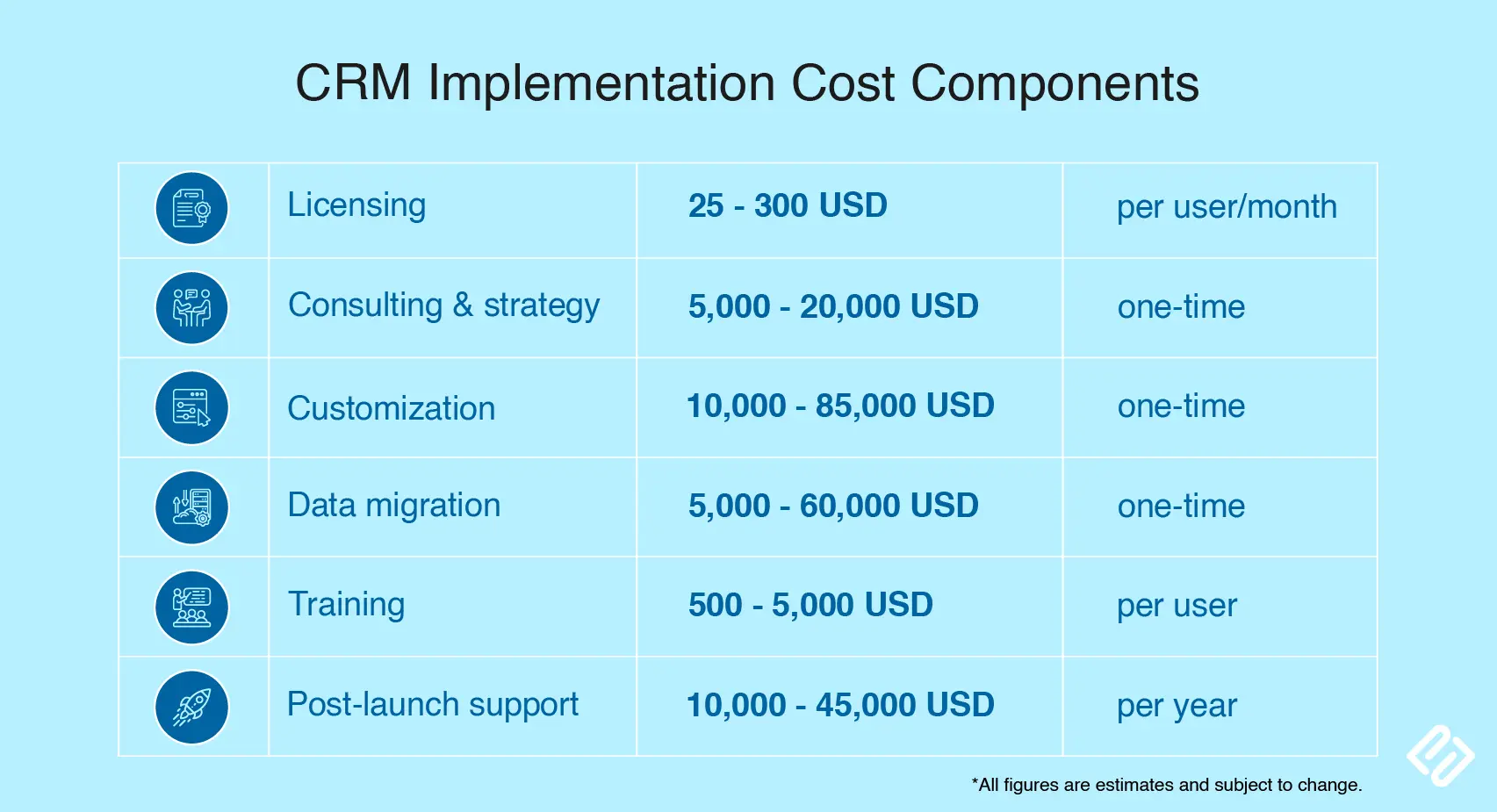
Disclaimer: These are estimated numbers. Since prices can change anytime, it’s good to double-check them.
1. Licensing costs
Salesforce editions have different tiers: Essentials, Professional, Enterprise, and Unlimited. The Essential is a low-tier plan, while the Unlimited is the highest-tier plan, ranging from $25- $300/user/month. Licensing costs alone can eat around 4-70% of Salesforce's spend over the years.
You can easily estimate your total cost by picking your products and determining how many team members will be using the tool. For example, you may only subscribe to Salesforce Sales Cloud (which is for sales pipeline and forecasting), or Service Cloud (popular for customer support), or Marketing Cloud (for multi-channel marketing).
We recommend a crawl-walk-run approach. Start with Sales Cloud, and then subsequently layer in specialized functionality. Add tailored or specialized products when there is a clear use case.
Go for Agentforce Marketing (formerly Marketing Cloud) if you have to launch a multi-channel campaign. Pardot is a great star solution for B2B marketing automation. The choice between Salesforce Marketing Cloud and Pardot depends on your needs.
Beginners kit (most of them are billed monthly):
- Sales Cloud: For pipeline and forecasting.
- Service Cloud: For customer service.
- Agentforce Marketing: For multi-channel campaigns.
- Pardot: Automation tool for marketing team (around $1,250 per month).
If you start with these services, it’s common to estimate a Year 1 budget in the range of about $25,000–$75,000, combining licenses and a focused initial implementation, with ongoing annual licenses usually sitting in the $10,000–$40,000 range after that.
2. Consulting and strategy
Now comes the consulting. Hiring a Salesforce consulting partner front-loads the costs. By bringing experts on board, you speed up implementation. They create a roadmap for strategic and successful implementation into your business.
Another big benefit of bringing experts on board is compressed implementation timelines -- from months to weeks. The consultant helps throughout different stages. Technically, you eliminate the chances of being stuck and prevent costly implementations.
You will need to pay anywhere from $5,000 to $20,000 for a consultant. That price tag depends on how messy the project is and how much 'heavy lifting' the professional has to do.
Plus, you may look for different models available, such as fixed-price, pay-per-hour, etc.
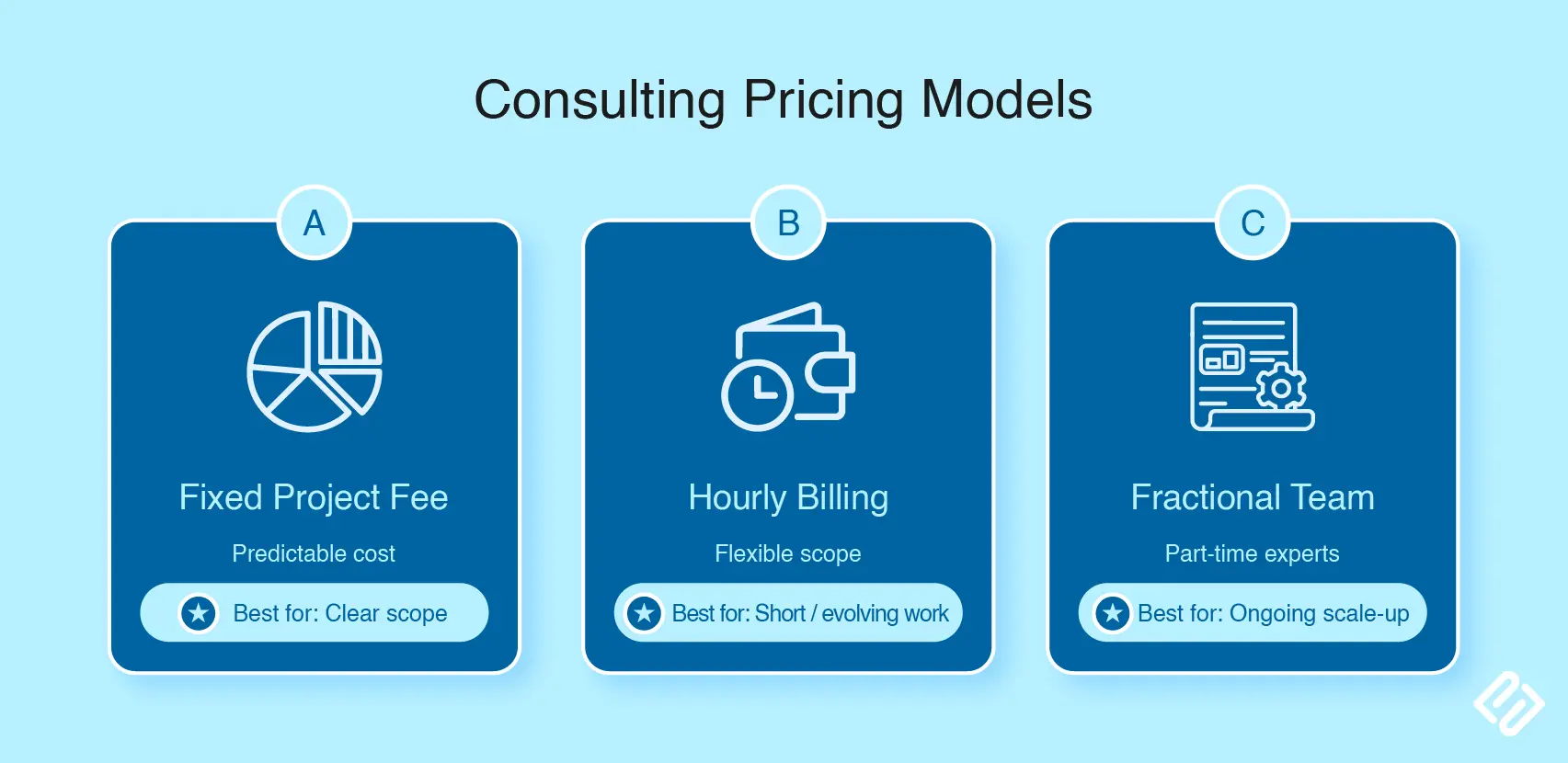
- Fixed Project Costs: You pay a one-time fee to execute tasks. The advantage is that it is predictable.
- Pay-Per-Hour: When you don’t want to pay a large fee upfront, you may go for this engagement model. It is ideal for shorter projects or ongoing support.
- Fractional Teams: They work part-time or on a retainer basis. They have hands-on experience in salesforce integrations and scaling, and are yet cost-effective.
3. Customization
Salesforce is highly customizable. Businesses can build custom UIs, create custom objects, build automation, and connect to external services. Another major factor that adds to the cost: customization.
You may need to pay anywhere between $10k-20k for Salesforce integration consultants for a basic level of customization. While advanced customization, which includes complex technical works such as integration of third-party services and custom app development, should come to around $80k over more.
4. Data migration
Data migration is the process of moving information into Salesforce. It could be expensive and slow if the data quality is poor. On average, poor-quality data can push costs up by as much as 50%.
Plus, it also depends on how much data needs to be moved in the Salesforce ecosystem. On average, expect $5,000 and $60,000 on data migration.
5. Training
If your employees aren’t trained to use it, setups can fall flat. Training ensures that the team can navigate the new terrain confidently. Salesforce provides several training options. You can opt for self‑paced online courses or in‑person sessions.
The cost and timeline for Salesforce project training are directly related to the type and complexity of the training required, which is itself driven by the scope of the implementation. In most cases, it is between $500 and $5,000 per user.
6. Post-launch support
Post-launch support includes system updates, troubleshooting, enhancements, occasional customizations, and too many to list here. In a year, it could be between $10,000 and $45,000.
Another major factor is location, which is why knowing the global labor rate is crucial for any business’s financial planning. That decision has a hefty price tag attached to it.
Here’s a quick look at how costs tend to differ:
- USA: Higher and start around $10,000–$15,000. Advanced projects’ costs can exceed $50,000.
- UK: About 20–30% higher than in the USA, largely due to labor rates and operating expenses.
- India: India is known for more cost‑effective Salesforce delivery. Basic implementations can start as low as $2,000–$5,000, with even advanced projects typically priced well below US and UK equivalents.
Let’s understand why it is crucial not to ignore this factor when looking to hire a Salesforce consultant.
To put these numbers into context. Here’s how much you may need to spend. Assume you are a mid-sized company that wants to design a custom solution that would require moderate customization. Let’s say this system would be used by 50 users, plus it requires data migration, too.
Salesforce implementation cost calculator (Simple estimate)
Use this quick formula to estimate your Salesforce implementation cost:
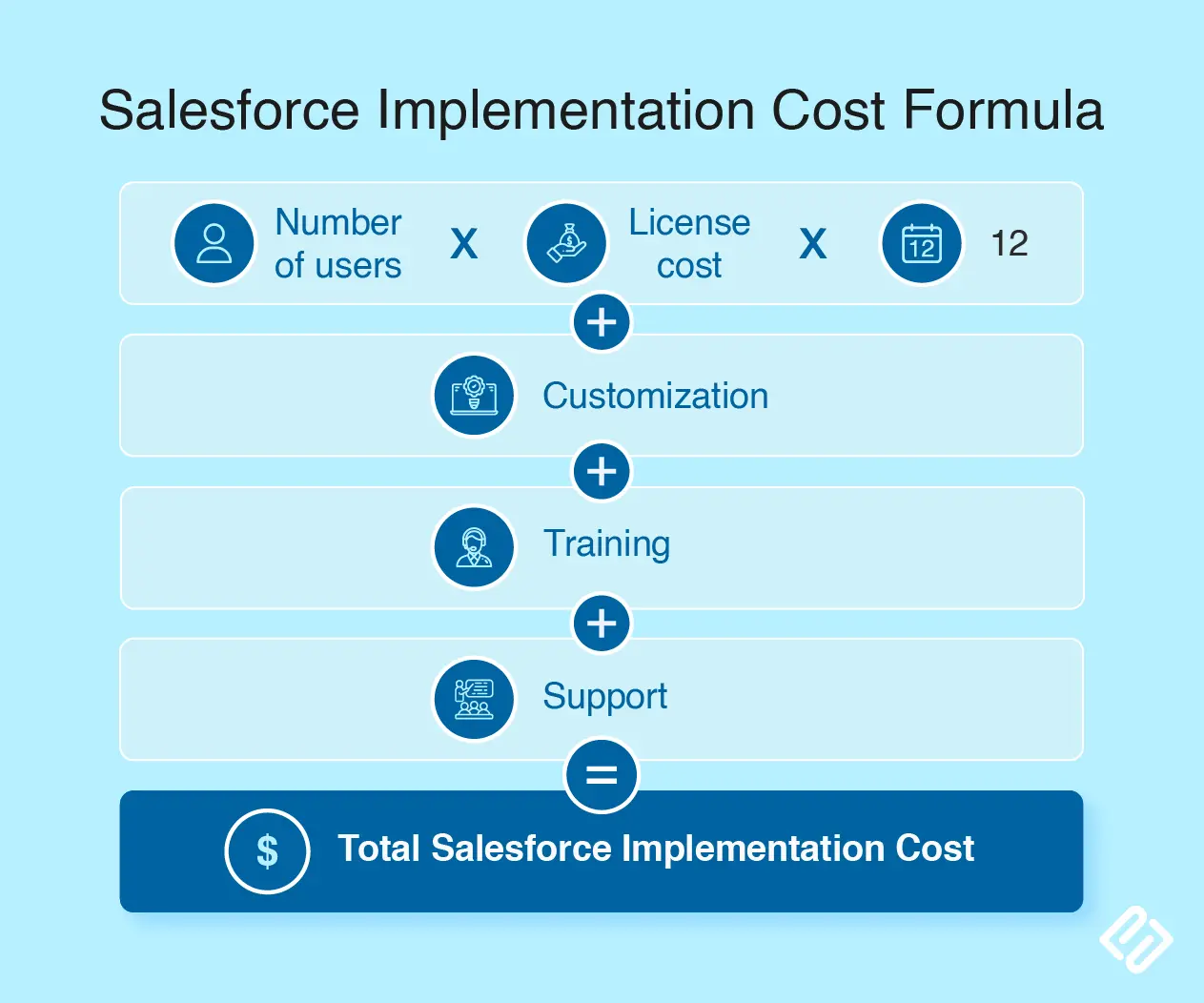
By this formula, the ballpark figure will be:
- Sales Cloud licensing – $150 per user per month for 50 users, totalling $7,500 per month
- Consulting and strategy – $15,000 as a one‑time cost
- Customisation – $30,000 for custom fields, workflows, and basic integrations
- Data migration – $20,000 for complex, multi‑source data
- Training – $5,000 for a mix of admin and end‑user sessions
In this scenario, you will need to make an investment of around $70k, with ongoing licensing fees of $7,500 per month. For more complex projects, the cost can climb up to $75,000–$150,000 .
Note: This is a hypothetical example; actual costs may vary.
Factors that influence Salesforce implementation pricing
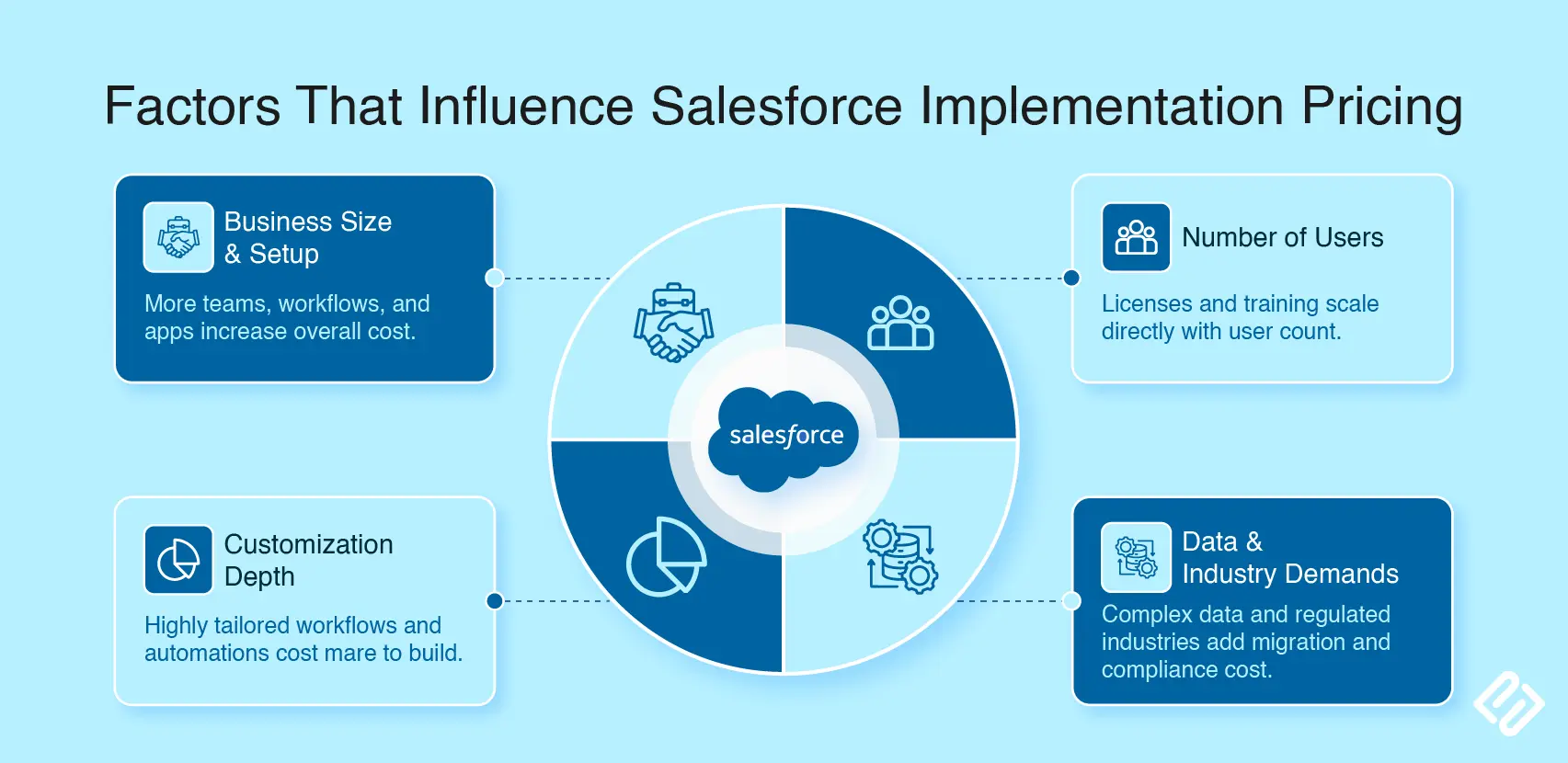
When working on cost optimization, start focusing on what you can adjust or control internally. To avoid reactive cost-cutting, you must have a profound understanding of internal operations, which will help you in the planning stage.
1. Business size and complexity
As your organization grows, your Salesforce setup naturally gets more complicated. The more users and the bigger your team is, the higher the cost you can expect. A small team with basic needs is going to see a much smaller price tag than a massive enterprise juggling several departments, custom-built apps, and heavy automation.
2. Number of users
The basis of pricing in Salesforce is per user per month. If you have more users, then you incur higher license fees. More employees also means increased time to train and adapt to the system.
3. Customization requirements
No two businesses run the same way. Even though Salesforce comes with plenty of built-in tools, you’ll probably need to tweak things to get the system exactly where you want it. Just keep in mind that the more specialized the build, the more you'll end up investing in the setup.
4. Data complexity
Migrating complex data sets from legacy systems can be challenging, especially if the data isn’t clean or well-organized. If your business has a lot of historical data or data in many formats, this will increase the cost of data migration.
5. Industry-specific needs
Certain industries—like finance, healthcare, or manufacturing—have to deal with strict regulations and complex operations. If you’re in healthcare, for instance, you'll need to factor in things like HIPAA compliance. These extra layers of security and specialized features definitely add to the total cost.
Cost optimization tips for Salesforce implementation
While Salesforce can be a significant investment, there are effective ways to optimize costs. Here are the top strategies:
1. Focus on key features
At the start of your Salesforce implementation process, focus on the basic functionalities that will help you get immediate benefits out of it. It’s better not to indulge in non-essential customization and add-ons at the beginning of your project, but once your team gets used to the basics, then you can move towards complicated features.
Tip: Focus on the features that address your most essential business use cases. This approach prevents overspending on extras that don’t align with your primary aims.
2. Implement in phases
Rather than deploying the whole Salesforce system all at once, think about doing it gradually. First, implement the core functionality and gradually include the more complicated customization and integration functionalities when your business expands.
Tip: Phasing your implementation can help prevent scope creep and unnecessary expenses. By focusing on high-priority features first, you can gain value early while leaving room for expansion.
3. Negotiate licensing and consulting fees
Salesforce licenses account for a major recurring cost. Feel free to negotiate your licensing costs as well as consulting rates.
Tip: Identify what you actually require, and bargain for an appropriate licensing plan that suits your requirements. Likewise, shop around for competitive consulting rates.
4. Work with a Salesforce consulting partner
With the guidance of Salesforce consulting partners such as Prioxis, you will be able to stay away from costly errors. This company provides all the assistance from the planning stage to customization, training, and support.
Tip: You could adopt a mixed strategy whereby internal staff perform simple jobs (such as data entry), and consulting partners deal with the complicated configurations. This will ensure that your Salesforce consulting partner's charge is reduced.
5. Invest in training
Training is important for adopting the application and ensuring that your Salesforce solution delivers its promised ROI. If users are not adequately trained, it may result in increased support costs and ineffective use of the tool’s capabilities.
Tip: Leverage the free Salesforce training tools, such as Trailhead. Offer specialized training according to individual job roles.
Industry-specific considerations from Prioxis
Different industries have different needs when it comes to Salesforce implementation. This can affect both the cost and complexity of the project. Let’s look at how some specific industries may need specialized Salesforce configurations:
1. Healthcare
Healthcare enterprises require customization of Salesforce to comply with regulations like HIPAA (Health Insurance Portability and Accountability Act). This will call for increased security and other particular processes for handling the data. The modification can prove expensive.
Note: In case you are operating in the healthcare sector, Salesforce Health Cloud is another option available to you. The drawback, however, is that it comes at higher price points ($250/user).
2. Financial services
In many cases, banks require complicated processes for handling the information of their customers as well as account management. Although Salesforce provides a Financial Services Cloud option, its implementation requires significant customization according to the unique demands of every financial organization.
3. Retail and eCommerce
In terms of retail and e-commerce companies, integration capabilities must be extended to include online sales solutions, inventory management software, and customer service solutions. In many cases, there is a necessity to provide complex automated solutions that could manage order processing, customer services, and even marketing campaigns.
How to calculate average cost Salesforce implementation?
As you think about adopting Salesforce for your company, you need to have knowledge of your unique requirements as well as how they are going to affect the total cost involved. The following are tips for estimating your costs:
1. Consult with a Salesforce partner
A certified Salesforce consulting partner can offer a more accurate estimate after assessing your business needs. They will work with you to develop a detailed implementation plan, covering everything from licensing to data migration, customization, and training.
2. Budget for future needs
As your organization grows, your Salesforce setup will have to grow alongside it. Make sure that in forecasting your costs, you account for future costs like additional user licenses, customizations, and integrations as required, as well as the cost of maintenance after deployment.
Final thoughts: Salesforce implementation costs in 2026
The implementation of Salesforce requires a considerable amount of money, yet its benefits for your company are great indeed. It is important to be aware of what affects the cost of the Salesforce implementation so that you do not end up spending too much on the project.
To make the most of your Salesforce investment:
- Plan Your Implementation: Start by finding your core needs and add more features and customizations as necessary.
- Hire Trusted Salesforce Consulting Partner: Prioxis can guide you through the process, ensuring that you avoid common pitfalls.
- Invest in User Training: Ensuring that your team adopts the platform is key to maximizing its value.
If you're ready to explore Salesforce for your business, contact Prioxis for a free consultation. Our team of experts can help you navigate the costs and ensure a smooth implementation.