


Summarise with AI:



You’re probably here because you’re thinking about moving to the cloud or already somewhere in the middle of it—and let’s be honest, it can feel pretty overwhelming. Cloud adoption is huge right now. Everyone from big enterprises to small businesses is jumping in because, in the long run, the benefits really do outweigh the upfront costs.
There are numerous cloud frameworks available, including AWS, Azure, and Google Cloud, and the market is experiencing significant growth. In fact, cloud adoption is expected to grow at a 26% CAGR from 2025 to 2034, and cloud migration services could hit USD 109.7 billion by 2034. That’s a lot of movement, and it’s easy to feel unsure about where to start or how to do things right.
That’s where the Azure Cloud Adoption Framework (CAF) steps in. It’s a structured, step-by-step guide from Microsoft designed to make your cloud journey way less daunting and much more successful.
In this article, we’ll walk you through Azure’s CAF, breaking down each phase so you can strategize, plan, and adapt to the cloud with ease. By the end, you’ll have a clear picture of how to make cloud adoption work for your business - and how to do it right the first time.
What You’ll Learn from This Guide
- Understand Azure CAF and why your business actually needs it.
- Why cloud adoption matters and how it can elevate the game for your business.
- Phases of the Azure CAF Walk through each phase—from strategizing to adopting and finally managing.
- Expert advice on Decisions, Insights on architecture, and resource tagging for a smooth migration.
- Where Expert Help Fits In: How professionals like Cloud Migration Service Providers can simplify the journey for you.
Let’s make sense of all these cloud complexities—without the headache.
What is the Azure Cloud Adoption Framework (CAF)?
Microsoft's Azure cloud framework is a comprehensive roadmap that guides you throughout your entire cloud journey. Whether you’re just considering moving to the cloud or knee-deep in planning, CAF gives you all the steps, tools, and templates needed to make your Azure cloud project successful.
This is not just a roadmap, but a practical action plan that goes beyond technology and ties cloud adoption to your business goals. It is a way to keep everyone, from your IT team to your top executives, aligned and rowing in the same direction without any hindrance.
Core Features of CAF
- Assessments Identify your current status and what's needed for a successful cloud transition.
- Templates and Tools Customizable tools to create a cloud strategy that’s uniquely yours.
- Guided Support A framework that aligns your cloud adoption with specific business outcomes.
Why is Cloud Adoption Essential for Business Growth?
Cloud adoption has become the core of growth for many businesses. Whether you’re a startup needing scalability or an established enterprise tired of heavy IT infrastructure costs, the cloud lets you stay competitive and nimble.
- Scalability Adjust resources on demand without a hefty infrastructure investment.
- Faster Deployment Roll out new services and products without long delays.
- Cost Saving Save up to 30% on IT operations by moving to the cloud.
- Security Azure’s security measures are top-notch, giving you peace of mind for your sensitive data.
If you’re not already looking at cloud solutions, there’s a good chance you’re falling behind.
The Six Key Phases of Azure Cloud Adoption Framework
Azure CAF breaks down the cloud adoption journey into manageable phases. Each of these phases helps you plan effectively, execute efficiently, and, ultimately, thrive.
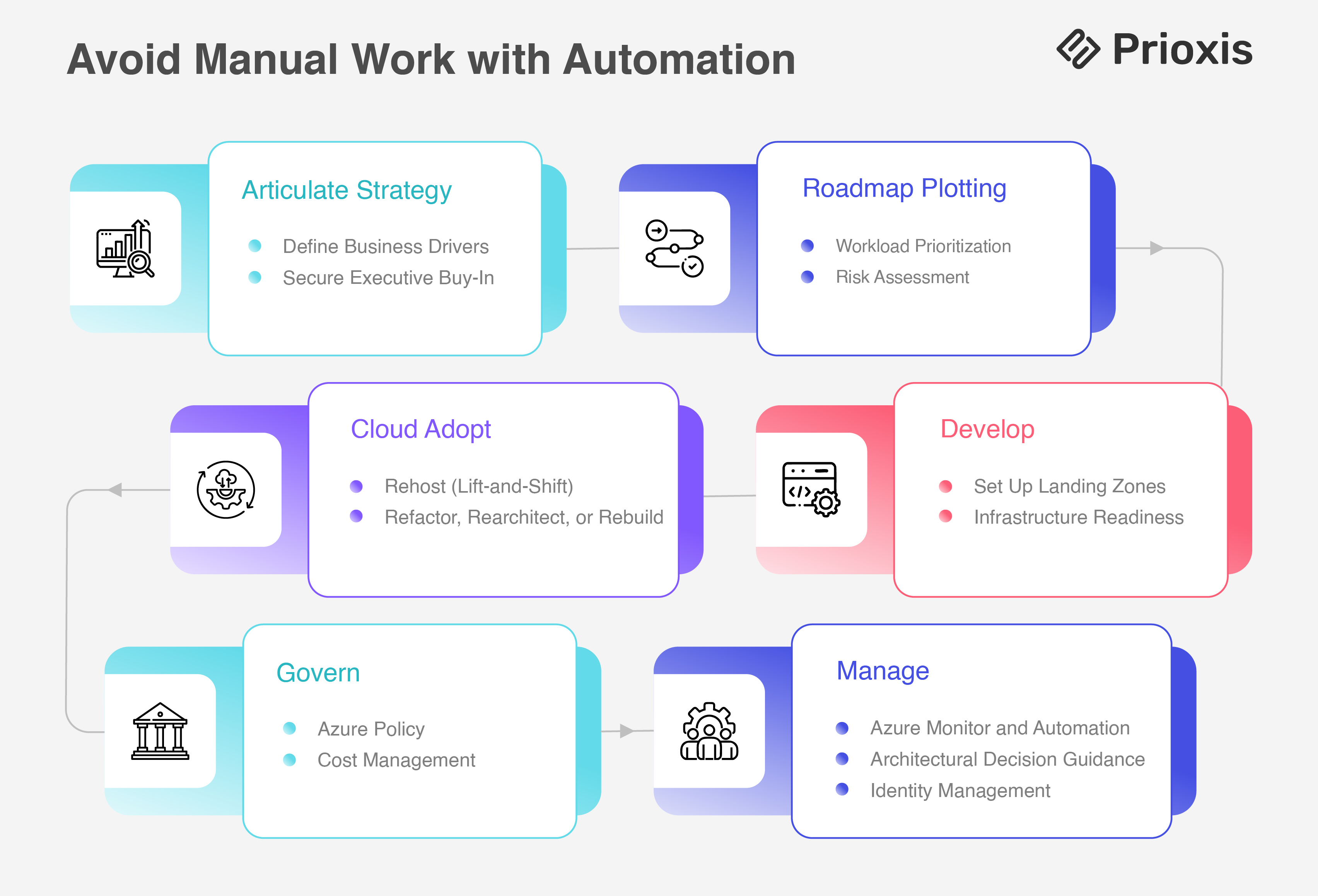
1. Strategy: Getting Everyone on Board
Instead of simply following trends or your competitors, you need to understand your business requirements and the reason behind your decision to migrate to the cloud. Whether you are trying to cut costs, improve scalability, or innovate more quickly, without clear, achievable KPIs and a well-defined intent, your cloud project outcomes can drift away from your desired results.
- Define Business Drivers Identify the “why” behind the cloud adoption—maybe it's to save costs or boost scalability.
- Secure Executive Buy-In Cloud adoption impacts everyone, and securing leadership on board is crucial.
2. Plan: Plotting the Roadmap
No one wants to jump into the cloud without a solid plan. You’ll need to figure out which parts of your business go to the cloud first and what stays on-premises, at least for now.
- Workload Prioritization Determine which workloads you prioritize first—focus on the low-risk, high-impact ones.
- Risk Assessment and Skill Gaps Do your team members need training? Is there a skills gap?
3. Ready: Build the Foundation
Think of this phase as getting your house in order before inviting guests. You need the right infrastructure, identity management, and landing zones for the workloads you're moving.
- Set Up Landing Zones Landing zones are where your workloads live once they’ve moved to the cloud.
- Infrastructure Readiness Make sure security and networking are solidly in place before migrating anything.
4. Adopt: Start the Move
This is where you finally start moving to the cloud. Azure gives you various ways to do this, depending on your needs.
- Rehost (Lift-and-Shift) This is the simplest method—moving things as-is.
- Refactor, Rearchitect, or Rebuild Adapt your applications for better performance, or build them from scratch.
Most businesses start with a lift-and-shift to get into the cloud quickly, but don’t stop there—keep evolving your applications to harness cloud-native benefits fully.
5. Govern: Keep It All Under Control
Cloud adoption without governance is a recipe for chaos. This phase is all about making sure your cloud environment stays compliant, secure, and efficient.
- Azure Policy Apply rules that keep resources compliant.
- Cost Management Avoid unexpected bills with Azure’s cost-management tools.
6. Manage: Optimize, Optimize, Optimize
Cloud adoption isn’t a “set it and forget it” endeavor. Constant monitoring and tweaks ensure you’re getting the best from your new setup.
- Azure Monitor and Automation These tools help you keep an eye on the performance and automate routine tasks.
- Continuous Improvement Look for opportunities to reduce, optimize Azure cloud costs and enhance performance.
- Architectural Decision Guidance When transitioning to the cloud, some key decisions make a huge difference in how well everything works down the line.
- Identity Management Matters Managing identities and ensuring secure access is fundamental. Use tools like Microsoft Entra ID to streamline and secure access across the board. Azure’s Role-Based Access Control (RBAC) is another vital tool for controlling who can access what—keep the right people in, and the wrong ones out.
- Resource Consistency Resource consistency means everything should work together without surprises. Use Azure Resource Manager templates to maintain consistent resource deployment.
- Policy Consistency Stick with Azure practices and policy to enforce company standards.
- Automated Consistency Utilize Azure landing zones—think of these as ready-made environments to host your workloads, adhering to set policies.
The Role of Azure CAF in Business Innovation
CAF is not just about getting you into the cloud; it’s about helping you grow once you’re there. Businesses use CAF to not only migrate but also innovate, using Azure’s capabilities to create new value.
- AI and Machine Learning Post-migration, Azure’s AI tools help you tap into advanced analytics and automation.
- Serverless Computing Forget managing infrastructure—Azure’s serverless functions let you run code with fewer headaches.
- Containers on Azure Azure’s Kubernetes support lets you manage containers seamlessly, scaling as needed.
By making these tools a part of your Azure cloud migration strategy, you can transform how your business works.
Getting Started with Azure CAF
Ready to take the plunge? Here’s how to start:
- Assess Current State Use Azure’s assessment tools to figure out where your company is right now.
- Define Objectives Align your cloud goals with your business priorities.
- Create Your Cloud Roadmap Use CAF’s templates to lay out a detailed plan.
- Seek Expertise Working with Cloud Migration Service Providers can smooth out the bumps in the journey.
Expert Help: Leveraging Cloud Migration Services
Migrating to the cloud is a significant step for businesses, no doubt about it.. That’s why working with a team that’s been there and done that before can make a world of difference.
Prioxis offers tailored Cloud Consulting Services that guide you from start to finish. From assessing your current environment to planning, migrating, and managing, our approach is all about minimizing risk and maximizing value.
Here’s How We Can Help
- Migration Assessment We figure out how ready you are and where improvements are needed.
- Tailored Migration Plan No cookie-cutter solutions—we customize a plan based on your specific needs.
- Cost Optimization It’s easy to overspend in the cloud. We help you find savings without losing efficiency.
- Secure Management Our team focuses on security, compliance, and performance, keeping your cloud environment in check.
Wrapping Up
If you’re moving to the cloud, Azure Cloud Adoption Framework is the toolbox you need to make the journey efficient, cost-effective, and secure. By breaking down each step of the journey from strategizing and planning to adopting and managing, you can ensure you’re getting the best out of your cloud experience.


Related Blogs
What Is Cloud-Native Architecture? Pros, Cons and Key Components
Explore practical insights from engineers who build scalable digital products every day.

Top Reasons To Hire A .NET Developer
Explore practical insights from engineers who build scalable digital products every day.

Top 9 Cloud Benefits: Productivity, Innovation & Growth
Explore practical insights from engineers who build scalable digital products every day.

Benefits of a Dedicated Development Team Model
Explore practical insights from engineers who build scalable digital products every day.
Top 12 Software Development Methodologies
Explore practical insights from engineers who build scalable digital products every day.
Why Cloud Integration Matters: Is Your Business Ready?
Explore practical insights from engineers who build scalable digital products every day.
.NET Core vs .NET Framework: Key Differences That Matter
Explore practical insights from engineers who build scalable digital products every day.
Why Is Azure DevOps the Key to Faster Business Growth Today?
Explore practical insights from engineers who build scalable digital products every day.
Azure DevOps Pipelines: Tools for Smoother Deployments
Explore practical insights from engineers who build scalable digital products every day.
On Premise vs Cloud Computing: Cost, Security & Scalability
Explore practical insights from engineers who build scalable digital products every day.