


Outsource .NET Developers: A Practical Guide for CTOs and Digital Leaders


Summarise with AI:



How growing start-ups and SMBs, solo-founders, and enterprises outsource .NET developers/development strategically, we will break it down in this breakdown.
Key Takeaway
- With a dedicated development agency or team, instead of waiting months to hire in‑house, you can speed up project delivery.
- Outsourcing is a cost-effective way to modernize legacy .NET applications without setting up an internal infrastructure.
- A good .NET development company reduces hiring and delivery risk while keeping your IP fully under your control.
- Flexible engagement models help you scale .NET capacity up or down as your strategy changes.
There are always times within an organization when the staff has too much on their plate. As Allen F. Morgenstern once said, “Work smarter, not harder.” Strategic outsourcing is how smart, successful companies maintain a balance between expansion and stability.
It works when you have to build a new product, manage an unexpected surge in demand, and so on. It is a practical and tested shortcut to an onboard experienced team or a solo developer, without having to spend months searching for professionals.
For many companies, the real benefit of software outsourcing services is that it lets internal teams focus on their main goals. This includes the systems and services that set them apart in the market. These important aspects cannot be shared with third parties.
This blog explains the benefits of outsourcing to a .NET development company. The content will also cover technical details and types of outsourcing. Finally, it will help you choose the right partner for your needs.
This guide is for product and technology leaders who need .NET experts without slowing down on hiring or delivery, including:
- Product‑based companies, with no in‑house engineers or technical expertise.
- Growing SMBs moving from off-the-shelf to custom solution, or upgrading their existing platform, or integrating new services.
- Enterprise and IT leaders who need more experts.
- Digital agencies and software vendors that want a reliable .NET partner.
Why Outsourcing Still Makes Sense Today?
- Hiring is slower and more challenging than ever, despite the fact that the world is more connected than ever before
- Most businesses need development-related work once in a blue moon. When their legacy systems start to become obsolete, keeping a team on round-the-clock doesn’t make any sense.
- Security, compliance, and integration challenges pop up every so often.
1. Hiring is slower and more challenging
Whether it is a hunt for AI engineers or developers for .NET-related projects, finding the right candidate is often complex. This is true of organizations with years of hiring experience.
Balancing the recruiter’s and applicant’s expectations, unconscious biases in hiring decisions, finding Mr. Perfect, and the evergreen challenges that are still unsolvable.
Hundreds of thousands of applicants' applications vanish into automated systems. 88% of recruiters find it challenging to hire and retain talent, with inflated salaries being among the key reasons.
2. Legacy .NET taxes every new feature
Another challenge across the IT industry lies in its foundation. The system you are managing still runs on a legacy .NET Framework. It has not been fixed just because it is working, so why force engineering?
Legacy systems not only hinder innovation, but they also silently inflate operational costs that leaders often do not realize.
We recently worked with a client who was struggling with long-running background jobs on their local workstations. Routines were taking nearly 4 hours to complete.
After reviewing their setup, we recommended migrating the application to .NET 10. This resulted in a processing time drop from 4 hours to almost half -- 2.5 hours. The hidden costs of legacy systems are:
- Older systems eat more memory and CPU.
- It is hard to recruit professionals to work on a decade-old framework
- In regulated industries, it is non-negotiable

3. Security, compliance, and integration's are ever-growing challenges
The truth is that companies today face more challenges than in the past. Technologies like cloud computing and AI have opened a Pandora’s box of unforeseen issues, even though they were meant to make our digital lives smoother.
Key Benefits of Outsourcing .NET
Outsourcing has been the proven method for companies – from start-ups to big players– to cut costs, bring in a skilled, dedicated, and experienced partner (development team or developers) without going through long hiring cycles.
Which explains why over 70% of organizations across the globe outsource at least one critical IT service -- cybersecurity, IT infrastructure, application development, etc.
Below are the benefits of outsourcing .NET developers.
1. Cost Reduction
The key benefit of software outsourcing is reduced development cost. Those who have a limited budget, or are running out of time, can bring in an experienced team or individuals without going through a prolonged hiring process.
Industry reports suggest that by turning to external partners, in some cases, firms are saving as much as 70% on development costs by outsourcing software development.
2. Access to Global Talent
Minimum wages vary widely from one country to another. To start, here’s how software development rates differ from one region to another. They are tentative rates sourced from various sources.
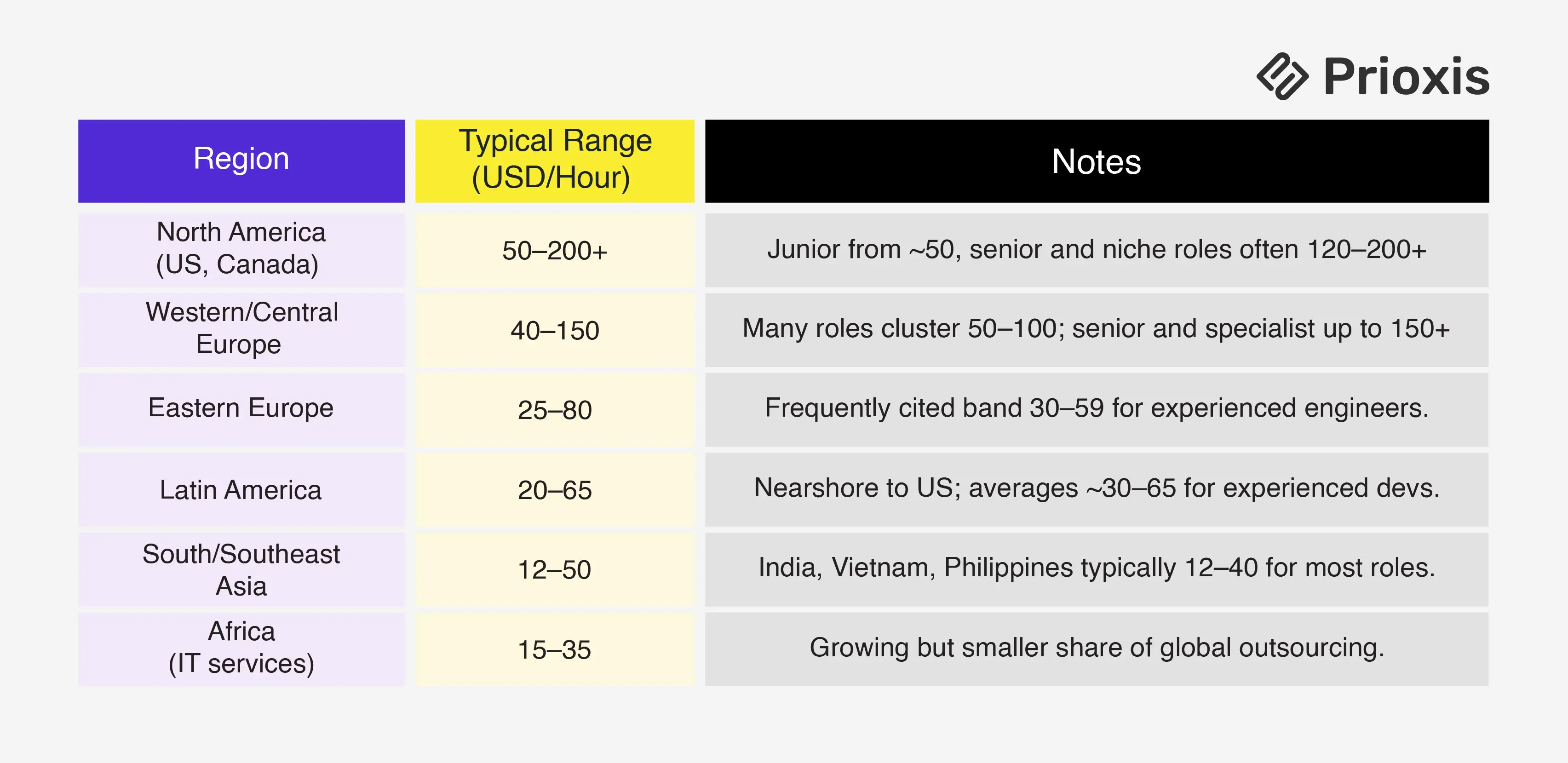
South/Southeast Asian countries are well-known for work quality on par with the USA/Europe, yet very cost-effective. There is no reason to limit yourself to where you live. You can onboard seasoned .NET developers, including experts who may not be available locally.
Regions like India, the Philippines, and Vietnam are some of the few popular options you can explore.
3. Faster Time-to-Market
Nearly 30% of projects by professional service organizations within software companies worldwide, from 2015 to 2023, were not delivered on time.
On-time project execution is a rare phenomenon in the IT service industry. Exceeding timelines also add to the cost. For many, outsourcing helps them achieve the timely completion of projects.
The developers, located in different time zones, facilitate uninterrupted development cycles, hence allowing for on-time completions.
4. Enhanced Scalability and Flexibility
With outsourcing, you can easily scale your development teams depending on your needs. This gives you flexibility in handling your resources. You do not have to worry about hiring and firing when your needs change.
5. Focus on Core Business Functions
You might want to hand off low-priority tasks to an external team to focus on important tasks. By outsourcing, you will be able to give more time and effort to those planned critical executions.
6. Reduced Risk
Common risks are talent shortages, which you can reduce by outsourcing a new team. Outsourcing also helps to reduce the risk of being out of touch with the latest technology.
Types of .NET Projects Best Suited for Outsourcing
Outsourcing can be ineffective if not effectively planned. Here's when outsourcing makes sense:
- Web Application Development (ASP.NET Core, Blazor, MVC)
When your core business isn't software, outsourced teams with expertise in ASP.NET Core or Blazor can build production-ready web apps faster. The benefit is that you can get it done without the overhead of recruiting and on-boarding developers.
- Enterprise Systems - ERP, CRM, HRMS
These systems communicate with almost every department. And their failure you cannot afford. It makes sense to outsource to specialists who know how to work with and integrate enterprise-grade .NET solutions. It reduces risk compared to handing it to a generalist team.
- Cloud-Native Development and Migrations
Moving to Azure or AWS isn't just a lift-and-shift operation. Experienced .NET outsourcing partners architect cloud-native solutions from the ground up — or modernize existing infrastructure without disrupting production environments.
- REST APIs and Microservices Architecture
Poorly designed APIs become technical debt fast. Outsourced .NET teams focused exclusively on back-end architecture deliver modular, versioned, and well-documented APIs that hold up under real load and future requirements.
- Legacy .NET Framework Modernization
If your application is still running on an old .NET Framework, it is more vulnerable. You can outsource a team to modernize the legacy tools or the platform on which your team works.
- Cross-Platform and Desktop Apps with .NET MAUI
Cross-platform development with MAUI requires niche experience that's hard to justify hiring for full-time. By outsourcing, you onboard specialists having extensive expertise in these frameworks.
- E-commerce Customization and CMS Development
Off-the-shelf platforms only go so far. Outsourced .NET developers build custom integration's, payment workflows, and content modules tailored to your business logic - not just what the template allows.
When to Consider Outsourcing .NET Development (3 Signs It’s Time for a Change)
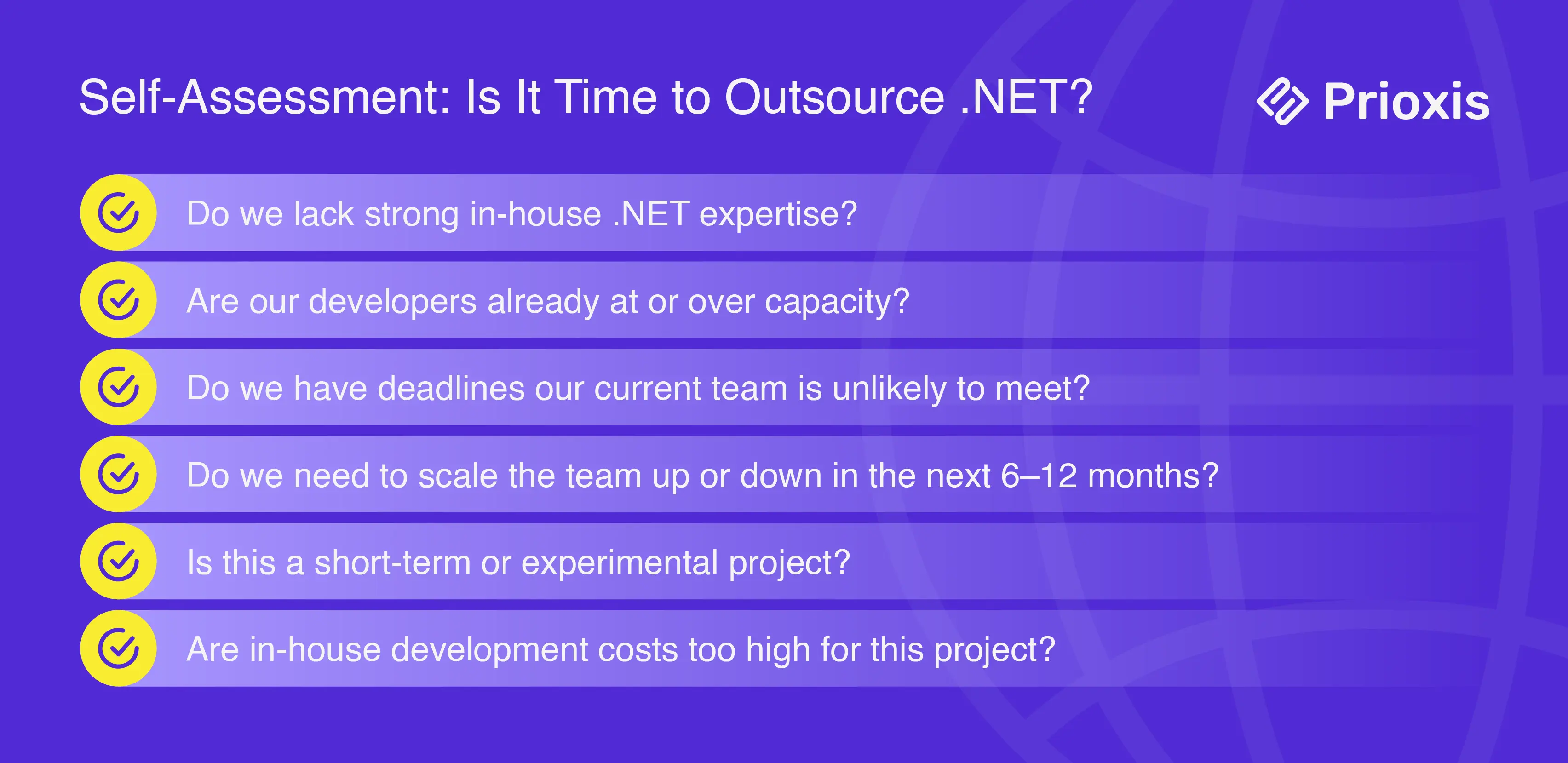
When should a company outsource .NET development?” This is the most important question that remains before you set out to hire a .NET development team. It applies to both those who are just starting out and those who have been in the industry for a long period of time.
- Skill and Resource Gaps
When you don’t have a team with .NET expertise, in-house developers are stretched thin, or you need an outsider with fresh thinking, then this is the time for outsourcing.
- Project and Timeline Demand
You can go for a dedicated development team model when deadlines are tight. It will compress your timeline without burning out your internal staff. Scaling up or down becomes a kind of contract adjustment, not an HR decision. And for short-term builds, outsourcing eliminates the cost burden of a permanent hire you don't actually need.
- Cost and Operational Efficiency
You want to build your product without investing in an infrastructural setup. Outsourcing cuts the hidden costs of full-time development - salaries, benefits, training, and office space.
If you don’t want to get into months of hiring and setting up a team, on-boarding project managers, if all these tasks are out of your domain, then outsourcing makes sense.
How to Choose the Right Software Development Outsourcing Partner?
1. Evaluate Their Work [Clutch, Testimonials, Third-Party Reviews]
Google search, social platform, and recommendations from AI tools are the first steps you may take to finalize the potential companies. Read reviews about the companies you might consider worth exploring. This is the starting point.
Find out if they could potentially address the issue you are facing. Explore their services, their projects, and works that will help identify if they are fit for your projects.
Look for the reviews on Upwork, Clutch, or in their testimonial section. It will help you identify their professionalism. Plus, for the project size in the Clutch. If they have worked in your industry and region, you can find reliable referrals.
2. Evaluate Their Technical Expertise
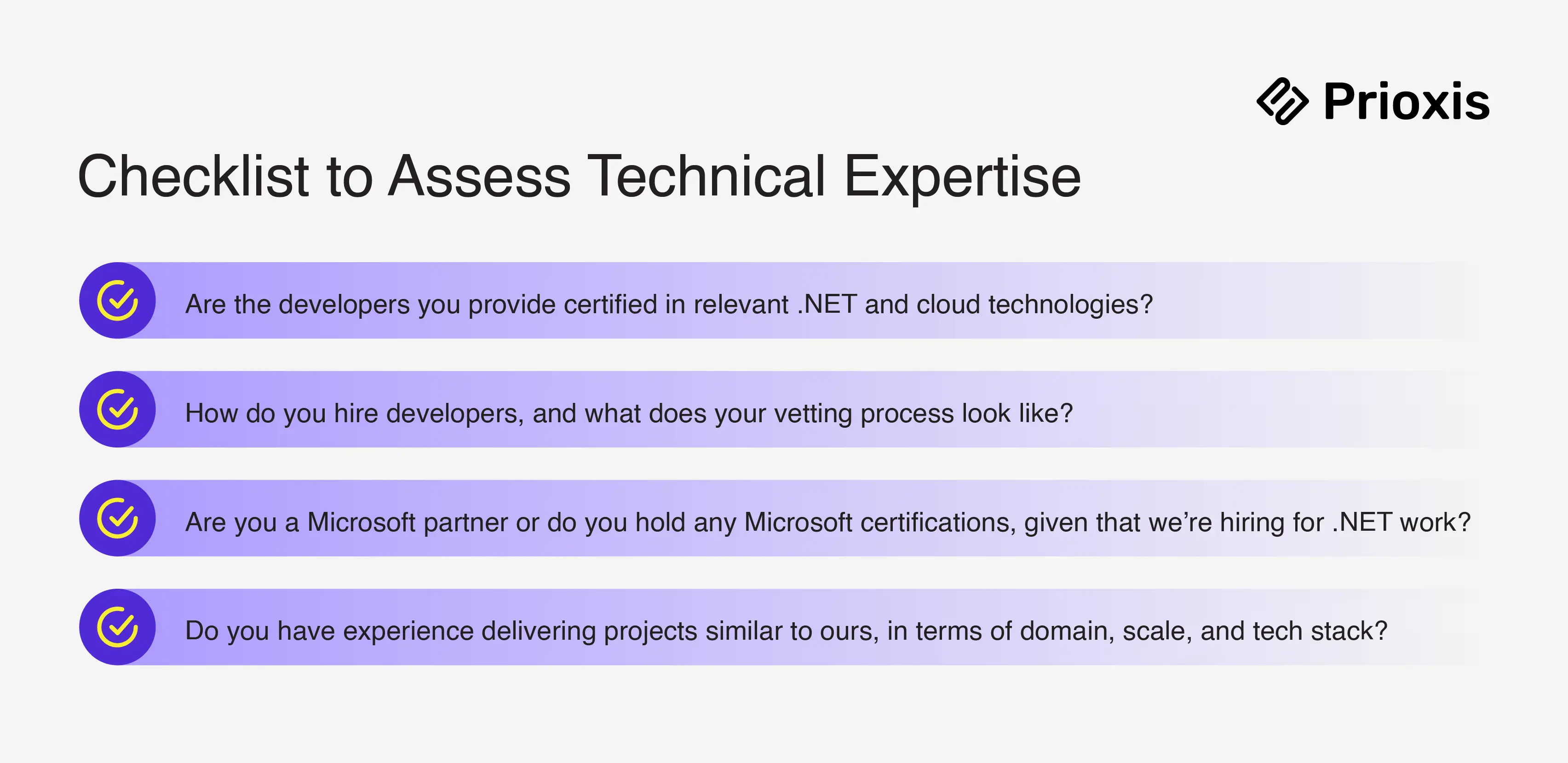
As a hiring company, create a checklist to assess their execution, technical, and soft skills. The partner should be able to describe their experience with current .NET development, rather than just saying, “We do apps.”
You can assess these qualities by asking how they handle upgrades, optimization, testing, diagnostics, and so on.
3. Check for domain experience where it matters
Check their domain expertise. Let’s assume you are working on a product for a regulated industry such as healthcare and finance. The development agency must understand the regional compliance requirements, such as GDPR/HIPAA, and HL7/FHIR. You can ask if they have worked earlier for the same industry, about project size, type, etc.
4. Go deep on security, compliance, and IP ownership
Instead of the generic “we take security seriously,” ask how they manage data protection, coding principles, access management, and incident response on live projects. If they’re working in a heavily regulated industry, look at how they architect for compliance from the beginning rather than an afterthought. Proper contracts for IP and code ownership, and an obvious exit strategy, are what prevent vendor lock-in.
5. Make sure their engagement model fits how you work
If they offer the engagement model, such as a dedicated team, fixed-price, or time & material, etc.
6. Test with a Pilot Project
Begin by evaluating performance, speed, quality, and communication before expanding the team.
Outsource Dedicated .NET Team with Prioxis
If you decide to onboard expert, certified .NET developers, the last thing you want is a long, vague on-boarding process. Here’s how a dedicated .NET developers with Prioxis typically comes together, step by step.
- Step 1: 45‑minute Discovery Call
We start with a focused working session. In 45 minutes, we map your current .NET landscape (apps, services, cloud). Know/identify where you’re blocked today.
- Step 2: Architecture and Team Plan within 24 hours
Within one business day, you get a short, concrete plan - not a 30‑page deck. It would include a suggested approach, a proposed team composition, and recommended engagement model.
You’ll also see how we handle IP ownership, security, and knowledge transfer from day one.
- Step 3: 2–4 week Pilot Sprint, with a real Deliverable
Before you commit long term, we run a short pilot. The goal is to validate how the team works with you. At the end of the pilot, you can continue, adjust, or walk away with the work delivered.
- Step 4: Scale the Squad up or down with your Roadmap
Once the team is embedded, you can increase or reduce capacity as your roadmap changes. You keep full IP ownership, no vendor lock‑in, and a clear path to transition work in‑house if you choose later.
Conclusion
Scaling your business doesn’t have to feel overwhelming, especially when you have the right talent by your side. You can grow without long-term contracts by hiring offshore software developers for your business.
This applies to enterprise software, cloud-native applications, API development, and updating old systems. Outsourcing can be safer and more helpful over time. This is true when you have trustworthy partners. Good communication is also important.
Finally, using the right engagement model makes a difference. In a world where speed and skill drive growth, outsourcing .NET development or building a team is not just a backup plan. It is a smart strategy.
Suppose you’re ready to lighten the load, accelerate delivery, and expand without stress. In that case, it’s time to take the next step: find the right outsourcing partner and start building the future you envision, one efficient sprint at a time.


Related Blogs

What Is Cloud-Native Architecture? Pros, Cons and Key Components
Explore practical insights from engineers who build scalable digital products every day.

Top Reasons To Hire A .NET Developer
Explore practical insights from engineers who build scalable digital products every day.

Top 9 Cloud Benefits: Productivity, Innovation & Growth
Explore practical insights from engineers who build scalable digital products every day.
Benefits of a Dedicated Development Team Model
Explore practical insights from engineers who build scalable digital products every day.

Top 12 Software Development Methodologies
Explore practical insights from engineers who build scalable digital products every day.

Why Cloud Integration Matters: Is Your Business Ready?
Explore practical insights from engineers who build scalable digital products every day.
.NET Core vs .NET Framework: Key Differences That Matter
Explore practical insights from engineers who build scalable digital products every day.

Why Is Azure DevOps the Key to Faster Business Growth Today?
Explore practical insights from engineers who build scalable digital products every day.
Azure DevOps Pipelines: Tools for Smoother Deployments
Explore practical insights from engineers who build scalable digital products every day.
On Premise vs Cloud Computing: Cost, Security & Scalability
Explore practical insights from engineers who build scalable digital products every day.